200 most important Astronomy topics - Sykalo Eugen 2023
The Tarantula Nebula
What If the Most Powerful Star Nursery Wasn’t in Our Galaxy?
Look up at the southern sky on a crisp, moonless night. You may not see it with your naked eye — it lies beyond our Milky Way, tucked within a companion galaxy. But through the lens of a telescope, the Tarantula Nebula lunges into view, not as a silent cloud but as a vast, glowing storm — a galactic maelstrom where stars are born by the thousands, where light screams and time kneels.
It’s called the Tarantula Nebula, officially designated 30 Doradus. A poetic name for a paradoxical place. At first glance, it’s mesmerizing — delicate tendrils of gas weaving across interstellar space like the legs of some ghostly cosmic spider. But don’t be fooled. This isn’t a place of serenity. It’s raw creation, chaos, violence — and perhaps, in some strange way, cosmic love.
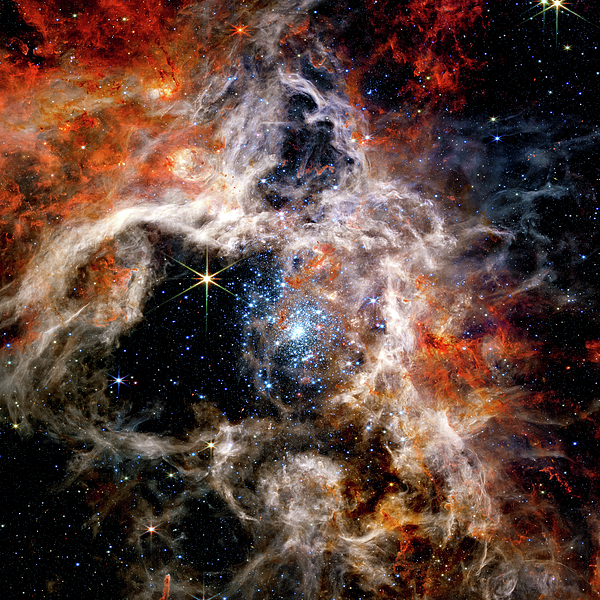
The Giant Next Door: Where Is the Tarantula Nebula?
Let’s start with the basics. The Tarantula Nebula is not even in our galaxy. It resides in the Large Magellanic Cloud (LMC), a satellite galaxy of the Milky Way located about 160,000 light-years away — a blink, cosmically speaking.
And it’s enormous. If the Tarantula were somehow transplanted into the Milky Way, it would dominate our skies. In fact, it’s the most active star-forming region in the entire Local Group — the small cluster of galaxies to which we belong. It’s over 1,000 light-years wide, and parts of it are so bright that they were visible to early telescopes even before astronomers understood what they were looking at.
But let me slow down. Size, distance, brightness — numbers, numbers, numbers. What matters isn’t just the data. What matters is the feeling. Imagine looking at a photograph from the Hubble Space Telescope — countless filaments of hydrogen glowing pink-red with star birth, knotted with newborn stars, some so massive they burn out in mere millions of years.
This is not a snapshot. It’s a time machine, catching the Universe in mid-creation.
A Stellar Nursery on Steroids
So what exactly is going on inside this beast?
The Tarantula Nebula is what astronomers call a H II region — a giant cloud of ionized hydrogen where ultraviolet radiation from newborn stars excites the gas, making it glow. But calling the Tarantula an “H II region” is like calling the Grand Canyon a “ditch.” It doesn’t do it justice.
The nebula contains hundreds of thousands of stars, many of them newborns or still forming. In particular, there’s a dazzling cluster at the heart of the Tarantula — R136. It’s not just a collection of baby stars; it’s home to some of the most massive stars ever observed, including R136a1, which is currently believed to be around 200 to 300 times the mass of our Sun.
Let that number settle in for a second. 300 Suns. That’s the upper limit of how massive stars can get before their own radiation pressure tears them apart.
These stars are also mind-blowingly luminous — millions of times brighter than our Sun. They live fast, burn hot, and die spectacularly.
Which brings us to the next point.
Explosions and Echoes: A Supernova Playground
Massive stars don’t die quietly. They go supernova — one of the most violent ends in the Universe. The Tarantula Nebula is littered with the scars of such explosions. One of the most famous examples? SN 1987A, the brightest supernova seen from Earth in nearly 400 years, exploded on the outskirts of the Tarantula in — you guessed it — 1987.
For weeks, it outshone every other object in its corner of the sky. Astronomers are still studying the debris cloud today, watching it expand, morph, fade. What they’ve learned is rewriting the textbooks — not just about supernovae, but about how elements are created, how shockwaves trigger further star formation, and how galaxies evolve.
Because here’s the cosmic irony: the death of one star may lead to the birth of others. Supernovae send shockwaves through surrounding gas clouds, compressing them, igniting the collapse that births new stars. It’s a cycle — destruction seeding creation.
Have you ever wondered how the atoms in your body got here? The calcium in your teeth? The iron in your blood?
They were forged in explosions like these. Possibly in places like the Tarantula Nebula.
Caught in the Webb: What the James Webb Space Telescope Reveals
You might be wondering — how do we know all this? After all, we’re peering into a nebula from 160,000 light-years away.
This is where the real magic begins — the magic of instruments.
The James Webb Space Telescope (JWST), launched in December 2021, has pulled back the curtain on the Tarantula like never before. Unlike Hubble, which sees primarily in visible and ultraviolet light, JWST sees in the infrared — perfect for peering through dense dust clouds.
In its very first year, Webb aimed its golden eyes at the Tarantula and sent back images that stunned even the scientists. Inside what once looked like murky chaos, Webb revealed intricate structures — bubbles, filaments, clumps — the architecture of creation. It saw protostars, those embryonic suns still gathering mass from the surrounding gas.
According to a 2023 NASA report, Webb’s data also gave clues about the chemical evolution of the region — how early stars influence the composition of later ones. It’s a laboratory for understanding not just star birth, but the evolution of galaxies themselves.
I remember the first time I saw one of Webb’s images of the Tarantula. It didn’t feel like looking at space. It felt like looking into a dream. Or maybe a cathedral — luminous, infinite, terrifying in its beauty.
Why the Tarantula Matters to Us
Alright. I know what you’re thinking.
It’s beautiful. It’s big. It’s full of stars. But why should I care?
Fair question. Let’s bring it home.
The Tarantula Nebula isn’t just a curiosity. It’s a time capsule, a mirror, and a teacher.
- Time Capsule: Because it’s far away, we’re seeing the Tarantula as it was 160,000 years ago. Long before humans invented writing, long before we tamed fire. We’re watching history unfold in slow motion.
- Mirror: Our Sun — and the solar system around it — likely formed in a similar nebula. Understanding the Tarantula helps us understand our own origins.
- Teacher: It offers insights into stellar evolution, the formation of elements, the dynamics of galaxies, and even the conditions that make planets — and life — possible.
And there’s something else. Something harder to quantify.
Looking at the Tarantula Nebula reminds us of what we don’t know. That even with the most advanced telescopes, there are still questions we can’t answer: Why do some gas clouds collapse into stars while others don’t? How massive can a star really get? What conditions lead to planet formation around these chaotic stellar nurseries?
Maybe I’m strange, but that not-knowing is comforting. It keeps the Universe alive. It keeps us searching.
A Cosmic Web That Connects Us All
The Tarantula Nebula is sometimes described as a web of stars. A fitting image. Because like any web, it connects — past and future, destruction and creation, the scientific and the spiritual.
Have you ever laid on your back and stared at the stars, wondering what’s out there?
Well, the Tarantula is one answer. A place where the Universe is still writing its story. Where light and shadow dance, where matter takes shape, where time loops and stars roar into being.
In a way, we all carry a piece of the Tarantula with us. The atoms in our bones were once inside a star like those blazing in that nebula. We are not separate from the cosmos. We are its children.
The Web and the Thread
I can’t pretend to understand everything about the Tarantula Nebula. No one can. It’s too big, too ancient, too sublime.
But maybe that’s the point.
Maybe the Tarantula isn’t just a nebula. Maybe it’s a reminder — that wonder still exists, that science and poetry can sit at the same table, that we can still be awestruck in an age of information.
So next time you look up — especially if you’re in the Southern Hemisphere — remember that somewhere out there, in the quiet arms of the Large Magellanic Cloud, a cosmic spider is weaving stars out of dust and fire.
And who knows? Maybe one of them will one day light the sky of a planet with eyes.