Most beautiful small birds - Sykalo Eugen 2024
Broad-billed Hummingbird (Cynanthus latirostris)
Identification:
- Species name: Broad-billed Hummingbird
- Scientific name: Cynanthus latirostris
- Family: Trochilidae (Hummingbirds)
- Order: Apodiformes (Hummingbirds)
- Subclass: Neornithes (Modern birds)
- Class: Aves (Birds)
Oh, hummingbirds! Just saying the word makes my heart do a little flutter-kick, a tiny, joyous echo of their own incredible wingbeats. And among the shimmering jewels of the avian world, there’s one that always makes me gasp a little louder, a little brighter: the Broad-billed Hummingbird, Cynanthus latirostris. Just the name itself, "broad-billed," hints at something unique, something special, like a secret whispered among the desert flowers. This isn't just a bird; it's a living, breathing spark of pure, concentrated energy, a tiny, iridescent miracle that flits through the sun-drenched air like a thought made manifest.
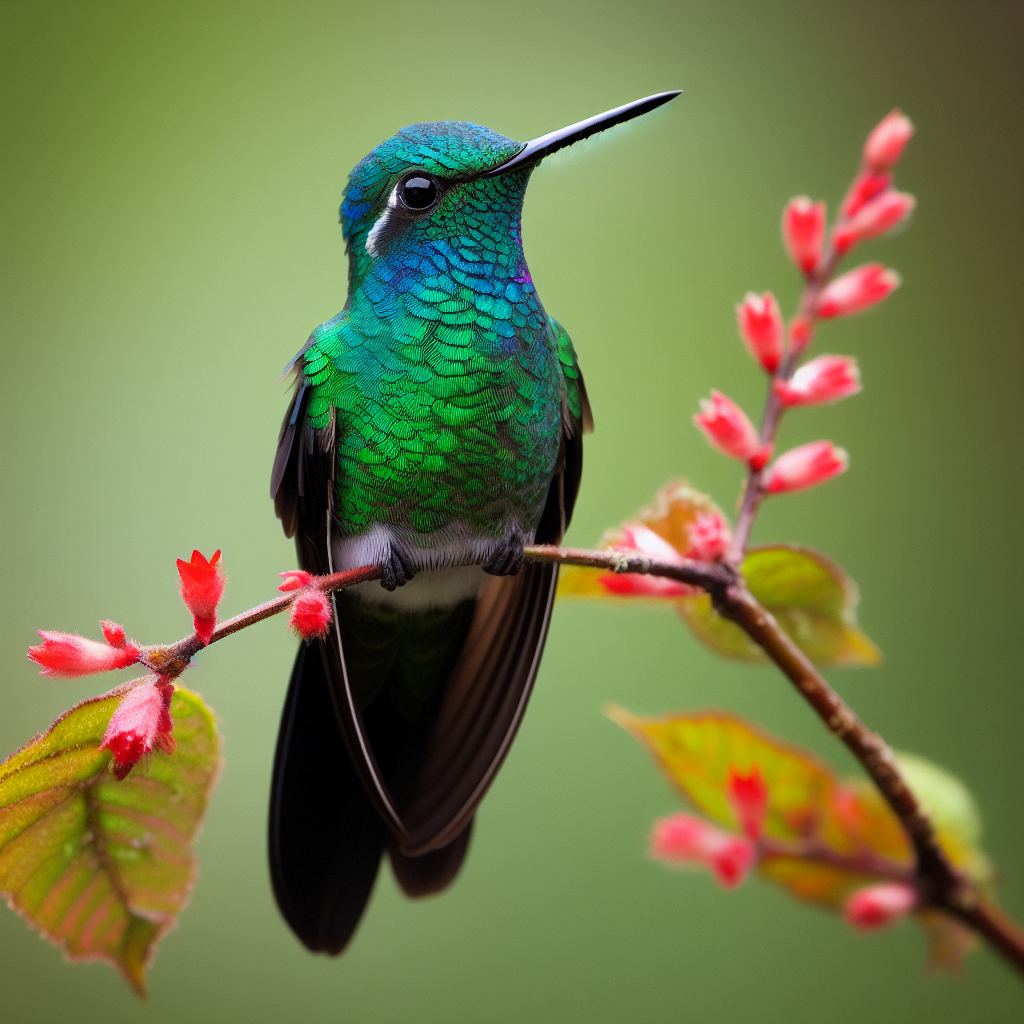
Imagine, if you will, a creature born from a painter's most vibrant dreams. The male Broad-billed Hummingbird, oh, he's a show-stopper! His throat and upper chest blaze with an almost impossible sapphire blue, a color so rich and deep it seems to absorb the very light around it and radiate it back, amplified. It’s not just blue; it’s electric blue, royal blue, a blue that sings. This fiery gorget (that’s the fancy term for their iridescent throat patch, and trust me, it deserves a fancy term!) is framed by a velvet-black face mask, giving him an air of masked mystery, a tiny Zorro of the desert blooms. His body? A shimmering emerald green, like he’s wearing a finely tailored suit spun from forest leaves. And then, the bill! Ah, the bill! It’s not just broad; it’s vibrantly red, tipped with black, like a tiny, perfectly manicured, scarlet spear. It's not just for sipping nectar; it's a declaration, a bold stroke of color against the desert’s muted tones. The females, while still beautiful, are a bit more understated, dressed in muted greens and grays, perhaps a hint of white under the eye, a silent testament to nature’s subtle artistry. But don’t let their softer hues fool you; they are just as fierce, just as vital, just as much a part of this shimmering dance.
These feathered marvels are diminutive dynamos, typically measuring around 3.5 to 4 inches (9 to 10 cm) from the tip of their fiery bill to the end of their tiny tail. Their wingspan? A mere 4.5 to 5 inches (11.5 to 13 cm), yet these delicate appendages beat at a furious, almost unbelievable rate, a blur that creates that characteristic hum, a living, breathing ode to speed and agility. And their weight? A minuscule 0.1 to 0.14 ounces (2.8 to 4 grams)! Think about that for a second. That's less than a single U.S. penny! It's as if nature decided to pack an entire superhero's worth of power into something lighter than a feather. This incredible lightness, coupled with their perfectly designed wings, allows them to perform aerial acrobatics that defy gravity itself. They can hover, dart, fly backward, and even upside down! Their unique ball-and-socket shoulder joint allows for this astonishing maneuverability, turning their wings into miniature, high-speed rotors. And that broad bill? It’s not just for show. It’s a perfectly adapted tool, a specialized probe designed to reach deep into the corollas of tubular flowers, extracting nectar with precision and efficiency. Their tiny legs and feet, almost vestigial, are hardly used for walking; instead, they are primarily for perching. It’s like they were built for flight, and flight alone, a pure embodiment of aerial grace.
The Broad-billed Hummingbird calls the sun-kissed, often arid landscapes of the southwestern United States and Mexico home. You’ll find them flitting through canyons, desert scrublands, and riparian areas, especially along streams and washes where flowering plants abound. They're not picky about altitude, ranging from sea level up to elevations of about 7,000 feet, which just speaks to their incredible adaptability. I've always felt a bit like a bird at heart, which is why their stories just grab me — and these hummingbirds, they truly exemplify the spirit of finding beauty and sustenance in seemingly harsh environments. They're ecological engineers of a sort, vital pollinators for the very plants that give their often-barren habitats life. Their presence signals a healthy, vibrant ecosystem, a living testament to the delicate balance of nature. Whoa, did you know that their distribution is often dictated by the presence of specific flowering plants, especially those with red or orange tubular flowers? It’s a beautiful dance between the pollinator and the pollinated, a partnership that has evolved over millennia.
Now, let's talk about dinner. These little jewels are primarily nectivores, fueling their frantic metabolism with the sugary goodness of flower nectar. They're particularly fond of agaves, ocotillo, chuparosa, and various cacti, but they’re not above supplementing their diet with small insects and spiders, which provide essential protein, especially during breeding season. They're like tiny, aerial bug zappers, snatching unsuspecting insects mid-flight or gleaning them from spider webs. Their foraging technique is a masterclass in efficiency: they hover in front of flowers, extending their long, brush-tipped tongues to lap up nectar at an astonishing rate. Their vocalizations are just as captivating as their appearance. The male's song is a high-pitched, buzzy trill, a sound that, to my ears, sounds like a tiny, joyful celebration, a declaration of territory and a serenade to potential mates. It’s not complex, but it’s distinctive, a little burst of pure energy. What does it say, I wonder? Is it a warning? A boast? Or just a little melody hummingbirds sing to themselves as they dance through the air?
And then, the magic of reproduction! Broad-billed Hummingbirds are fiercely territorial, especially the males, who will aggressively defend their feeding grounds and nesting sites. The females, however, are the architects of the next generation. They build exquisite cup-shaped nests, often in shrubs or small trees, skillfully weaving together plant fibers, spider silk, and even bits of lichen, camouflaging them perfectly with their surroundings. My grandma always used to say, "The smallest things often hold the greatest beauty," and these nests are a perfect example. They typically lay two tiny, pea-sized white eggs, which the female incubates for about 15 to 16 days. The chicks, born blind and featherless, are incredibly vulnerable, but under the devoted care of their mother, they grow rapidly, fledging in about 20 to 23 days. It's a testament to the sheer dedication of these tiny mothers, who, with no help from the male, raise their brood, tirelessly ferrying nectar and insects to their hungry offspring. These hummingbirds are mostly resident throughout their range in Mexico, but populations in the northernmost parts of their range, like Arizona, are partial migrants, undertaking impressive journeys south for the winter. It’s a thrilling tale of a grand adventure, a small creature taking on the vastness of the continent, guided by an ancient instinct, a vivid testament to their inner compass.
Here's a truly astounding fact: Broad-billed Hummingbirds, like all hummingbirds, have the highest metabolic rate of any endothermic animal, a truly astonishing biological feat. To sustain this furious pace, they must consume vast quantities of nectar, often eating more than their body weight in a single day! Imagine having to eat your entire body weight every single day! It's like they're living life in fast-forward, every moment a vibrant, energetic burst. And their interaction with humans? While they’re wild creatures, their love for nectar often brings them into our gardens, especially if we provide feeders or nectar-rich plants. One time I was watching a Broad-billed Hummingbird and I swear, it winked at me when it caught that tiny gnat mid-air! It’s a joyful connection, a reminder that even in our urbanized world, wild beauty is just a feeder away. They are also incredibly important pollinators, ensuring the continued health and diversity of many plant species, especially those in their often-harsh desert habitats.
Thankfully, the Broad-billed Hummingbird is currently listed as a species of "Least Concern" by the IUCN, meaning their populations are generally stable. This is a wonderful thing, a testament to the resilience of nature and, perhaps, a glimmer of hope that we can coexist with these vibrant creatures. However, habitat loss and fragmentation, often due to human development, remain potential threats. But there's so much we can do! Planting native, nectar-producing flowers in our gardens, especially in their native range, can create vital feeding grounds and corridors. Reducing pesticide use, protecting natural riparian areas, and simply appreciating these tiny marvels can all contribute to their continued success. Each of us can be a champion for these iridescent ambassadors of the desert, fostering an environment where their hum continues to grace the air.
And so, the Broad-billed Hummingbird, a tiny jewel of the desert, reminds us that even in the smallest package, nature can contain boundless energy, breathtaking beauty, and an indomitable spirit. They are a testament to the incredible adaptations that allow life to flourish in even the most challenging environments. Witnessing one is not just seeing a bird; it's experiencing a living, breathing spark of pure joy, a vibrant exclamation point in the grand, ongoing story of life. Go ahead, step outside, plant a flower, and let the hum of a hummingbird fill your heart with its effervescent song.