Most beautiful small birds - Sykalo Eugen 2024
Swainson's Thrush (Catharus ustulatus)
Identification:
- Species name: Swainson's Thrush
- Scientific name: Catharus ustulatus
- Family: Turdidae (Thrushes)
- Order: Passeriformes (Songbirds)
- Subclass: Neornithes (Modern birds)
- Class: Aves (Birds)
Oh, friends, have you ever truly listened to the forest? Not just heard the rustle of leaves or the distant rumble of traffic, but truly opened your ears to the hidden symphonies? Because if you have, chances are, you've been serenaded by a true maestro, a secret jewel of the avian world: the Swainson's Thrush, Catharus ustulatus. And let me tell you, this isn't just a bird; it's a living, breathing testament to nature's quiet artistry, a creature that embodies elegance and perseverance in equal measure. Just imagine, a small, unassuming feathered being, often blending into the dappled light of the understory, yet possessing a voice that can make your soul hum. It’s like discovering a hidden chamber in a grand old library, filled with untold stories and breathtaking melodies!
When you first glimpse a Swainson's Thrush, you might think, "Oh, a little brown bird." But wait! Lean in closer, let your eyes adjust to the forest's subtle palette. You’ll see that it's far from just brown. Its upperparts are a warm, inviting cinnamon-brown, a shade that reminds me of freshly baked gingerbread, perfectly camouflaging it amongst the forest floor. But then, bam! — the magic happens. Its underparts burst forth in a creamy white, absolutely splashed with a constellation of dusky spots across its breast and flanks. It’s like nature decided to try its hand at abstract art, and the result is simply mesmerizing. And the eyes! Framed by a pale, almost buffy eye-ring that sweeps back like a tiny, elegant comma — this is a bird with a secret, a shy smile, a hidden wink. Males and females? Practically identical, which always makes me chuckle. No flashy peacock displays here; they’re all about understated charm and a shared commitment to subtle beauty.
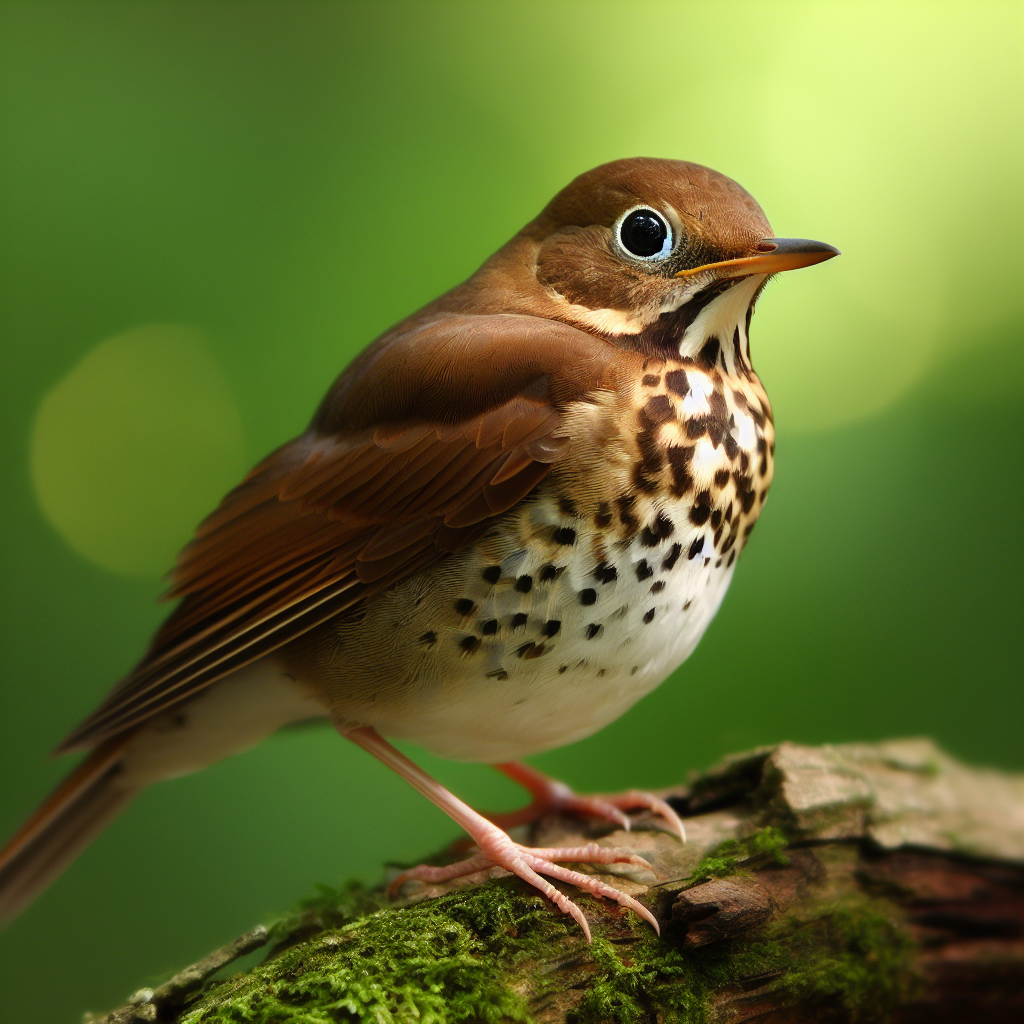
Now, about its size: this little dynamo typically measures in at about 18 cm (7.1 inches) from beak to tail, with a wingspan that gracefully unfurls to around 30 cm (11.8 inches). And for all that feathered brilliance, it weighs a mere 27-30 grams (1 to 1.1 ounces). Think about it! A creature roughly the weight of a few strawberries, yet it embarks on epic journeys and pours out a song that could rival any opera star. These modest dimensions are not some oversight of evolution; no, they are perfectly engineered for its life amongst the dense foliage. Its slender, pointed beak, a precise surgical tool, is perfect for plucking insects from leaves or probing soft earth for a juicy worm. Its relatively long, strong legs and nimble toes are built for hopping and perching through tangled undergrowth, not for dashing across open plains. And those wings? While not built for soaring like an eagle, they are marvels of endurance, designed for swift, agile bursts through the trees and, of course, those incredible long-distance migrations we’ll get to later. This thrush, my friends, is a woodland ninja, a silent, swift shadow that suddenly bursts into melodious life!
The Swainson's Thrush is a creature of the forest, a true connoisseur of the green canopy. You'll find it flitting through coniferous, deciduous, and mixed woodlands, often preferring areas with dense undergrowth and a good supply of mature trees. It's not one for wide-open spaces; no, this is a bird that thrives in the dappled light and cool shade of the forest's embrace. From the lush, temperate rainforests of the Pacific Northwest (where I've had the immense pleasure of hearing them on misty mornings, and let me tell you, it's like a dream set to music!) to the boreal forests stretching across Canada and into the northern United States, and even down through mountainous regions into Central and South America during their wintering months. Their preference for specific microhabitats within these broader ranges—like riparian zones or areas with abundant berry-producing shrubs—is fascinating. It’s almost as if they have their own real estate agents, seeking out the perfect blend of food, shelter, and a quiet spot to raise a family. This pickiness isn't just whimsy; it means they play a crucial role in these ecosystems, helping to control insect populations and disperse seeds, becoming an integral thread in the vibrant tapestry of the forest.
Now, let's talk about dinner, shall we? Our little thrush is quite the omnivore, a true gourmet of the forest floor. In the breeding season, it's all about protein! They're insectivores extraordinaire, feasting on beetles, ants, caterpillars, flies, and a host of other invertebrates. They’ll dart through the undergrowth, snatching insects from leaves or diving gracefully to pluck a juicy morsel from the ground. It's a quick, efficient, and surprisingly elegant hunting dance. But come late summer and autumn, when the days shorten and the chill whispers of winter approach, their diet shifts dramatically. Berries become the star of the show — elderberries, blackberries, serviceberries, and a whole smorgasbord of other wild fruits. This change isn't just about taste; it’s a crucial fuel-up for the epic journey ahead. They’re like tiny energy-storage units, meticulously packing away every calorie for the grand adventure that awaits.
And that song! Oh, that song! If you’ve heard it, you know. If you haven’t, prepare to be enchanted. The Swainson’s Thrush's song is a spiraling, ethereal melody, often described as a series of flute-like, ascending whistles, building in pitch and intensity before fading away like a whispered secret. It’s truly otherworldly, often heard in the quiet magic of twilight or the first blush of dawn. It doesn't just sing; it weaves a soundscape. Is it a lullaby? A secret code? A lament for lost sunsets? Perhaps it’s a bit of all three, a complex symphony of territorial defense, mate attraction, and pure, unadulterated joy in existence. I once heard one singing from a dense thicket, and I swear, it felt like the forest itself was exhaling music, a breath of pure, unfathomable beauty. And their calls? A sharp, almost metallic "whit!" or a soft "pup" are their go-to conversational snippets, keeping tabs on each other in the dense woods.
When it comes to reproduction, these thrushes are diligent architects. Their nests are neat, cup-shaped structures, typically built in a small sapling or shrub, often near the trunk, well-concealed by foliage. They’re master weavers, using twigs, moss, grass, and even mud to create a sturdy, cozy cradle for their future offspring. My grandma always used to say that a bird’s nest is a testament to patience and love, and seeing a thrush nest, so meticulously crafted, you can’t help but agree. The female typically lays 3-5 pale blue or greenish-blue eggs, often speckled with brown. Incubation takes about 12-14 days, and both parents are devoted caregivers, constantly ferrying insects to their insatiably hungry chicks. The young fledge in another 10-14 days, still fluffy and a bit clumsy, but already imbued with the thrush’s quiet determination. It’s a fast-paced, demanding life, but the dedication is palpable.
And then, the migration. Ah, the migration! This isn’t just a flight; it’s an epic, mind-boggling odyssey! Swainson's Thrushes are long-distance migrants, embarking on journeys that span thousands of kilometers. From their breeding grounds in North America, they undertake a spectacular annual pilgrimage south, wintering in Central and South America, as far as Argentina! Imagine a creature so small, crossing vast oceans, deserts, and mountain ranges, navigating by the stars and the Earth's magnetic field. It’s a testament to evolutionary brilliance, a testament to the sheer, unyielding will to survive. They often migrate at night, covering incredible distances, fueled by those berries they meticulously stored. It's a grand adventure, fraught with peril, but one they undertake with unwavering resolve, a feathered beacon of wanderlust. They are generally solitary during migration, though they may gather in loose groups at stopover sites, refueling stations on their incredible aerial highways.
Socially, Swainson’s Thrushes are pretty independent. During the breeding season, they’re largely solitary or found in pairs, fiercely defending their nesting territories with those spiraling songs and occasional scuffles. They’re not flocking birds like starlings; they prefer their own space, their own quiet corner of the forest. However, outside of the breeding season, particularly during migration and on their wintering grounds, they can be found foraging in mixed-species flocks, a sensible strategy for finding food and perhaps offering a bit of safety in numbers. It’s a practical adaptation, a lesson in finding balance between self-reliance and communal wisdom.
Now for a truly astounding fact! Did you know that the Swainson's Thrush, despite its delicate appearance, is a surprisingly efficient aerial hunter? While they primarily forage on the ground or in foliage, they are perfectly capable of sallying forth, like a tiny feathered jet, to snatch insects right out of the air! It’s a testament to their adaptability and their incredible agility. And here’s a quirky thought: if a bird could wink, I swear a Swainson’s Thrush would be the one. Their silent, swift movements and their often-hidden presence in the forest undergrowth give them an air of knowing secrets, of being privy to the quiet mysteries of the woodland. One time, I was patiently watching one foraging, and it suddenly paused, tilted its head, and just for a fleeting moment, I felt like it was looking right at me, a silent acknowledgment across species. A purely human projection, I know, but it was a delightful thought!
As for their conservation status, the Swainson's Thrush is currently listed as "Least Concern" by the IUCN, which is wonderful news! However, like many forest-dwelling birds, they face ongoing threats from habitat loss and fragmentation due to logging, development, and agricultural expansion. Climate change also poses a risk, altering their breeding and wintering grounds and potentially impacting their food sources. But there’s so much hope! Organizations worldwide are working tirelessly to protect migratory bird stopover sites and preserve intact forest ecosystems. Sustainable forestry practices, creating bird-friendly gardens, and reducing pesticide use are all ways we, as individuals, can make a positive impact. Every time we choose to support conservation efforts, or even just take a moment to appreciate the wild spaces around us, we're casting a vote for the continued existence of these incredible creatures. It's about remembering that we share this magnificent planet, and every effort, no matter how small, ripples outward.
So, the next time you find yourself strolling through a quiet wood, pause. Close your eyes, and just listen. Listen for that spiraling, ethereal melody, that whispered secret from the depths of the forest. It might just be the Swainson's Thrush, the veiled virtuoso, singing its timeless song. And when you hear it, remember the epic journey it has taken, the silent strength it possesses, and the sheer, breathtaking beauty it brings to our world. It's a reminder that even the smallest, most unassuming creatures can hold vast, untold wonders within their feathers, waiting for us to simply stop, listen, and let the magic unfold. Go on, let your heart hum along!