Calculus AB and Calculus BC
CHAPTER 3 Differentiation
C. THE CHAIN RULE; THE DERIVATIVE OF A COMPOSITE FUNCTION
Formula (3) says that
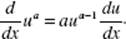
This formula is an application of the Chain Rule. For example, if we use formula (3) to find the derivative of (x2 − x + 2)4, we get

In this last equation, if we let y = (x2 − x + 2)4 and let u = x2 − x + 2, then y = u4. The preceding derivative now suggests one form of the Chain Rule:

as before. Formula (3) the previous page gives the general case where y = un and u is a differentiable function of x.
Now suppose we think of y as the composite function f (g(x)), where y = f (u) and u = g(x) are differentiable functions. Then
Chain rule
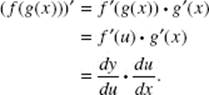
as we obtained above. The Chain Rule tells us how to differentiate the composite function: “Find the derivative of the ‘outside’ function first, then multiply by the derivative of the ‘inside’ one.”
For example:
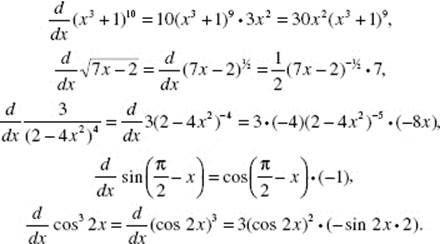
Many of the formulas listed above in §B and most of the illustrative examples that follow use the Chain Rule. Often the chain rule is used more than once in finding a derivative.
Note that the algebraic simplifications that follow are included only for completeness.
EXAMPLE 1
If y = 4x3 − 5x + 7, find y ′(1) and y ″(1).
SOLUTION: 
Then y ′(1) = 12 · 12 − 5 = 7 and y ″(1) = 24 · 1 = 24.
EXAMPLE 2
If f (x) = (3x + 2)5, find f ′(x).
SOLUTION: f ′(x) = 5(3x + 2)4 · 3 = 15(3x + 2)4.
EXAMPLE 3

SOLUTION: 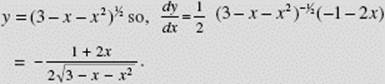
EXAMPLE 4
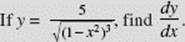
SOLUTION: 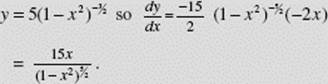
EXAMPLE 5
If s(t) = (t2 + 1)(1 − t)2, find s ′(t).
SOLUTION: 
EXAMPLE 6
If f (t) = e2t sin 3t, find f ′(0).
SOLUTION: 
Then, f ′(0) = 1(3 · 1 + 2 · 0) = 3.
EXAMPLE 7

SOLUTION: 
Note that neither f (v) nor f ′(v) exists where the denominator equals zero, namely, where 1 − 2v2 = 0 or where v equals 
EXAMPLE 8
If  x ≠ 0, find f ′(x).
SOLUTION: 
EXAMPLE 9
If y = tan (2x2 + 1), find y ′.
SOLUTION: y ′ = 4x sec2 (2x2 + 1).
EXAMPLE 10
If x = cos3 (1 − 3θ), find 
SOLUTION: 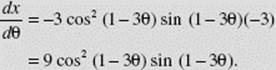
EXAMPLE 11
If y = e(sin x) + 1, find 
SOLUTION: 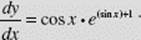
EXAMPLE 12
If y = (x + 1)ln2(x + 1), find 
SOLUTION: 
EXAMPLE 13
If g(x) = (1 + sin2 3x)4, find 
SOLUTION: 
Then 
EXAMPLE 14
If y = sin−1 x +  find y ′.
SOLUTION: 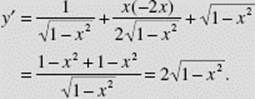
EXAMPLE 15
If u = ln  find
find 
SOLUTION: 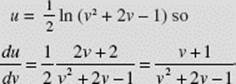 .
.
EXAMPLE 16
If s = e−t(sin t − cos t), find s ′.
SOLUTION: 
EXAMPLE 17
Let y = 2u3 − 4u2 + 5u − 3 and u = x2 − x. Find 
SOLUTION: 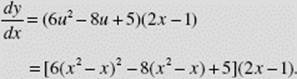
EXAMPLE 18
If y = sin (ax + b), with a and b constants, find 
SOLUTION:  = [cos(ax + b)] · a = a cos(ax + b).
EXAMPLE 19
If f (x) = aekx (with a and k constants), find f ′ and f ″.
SOLUTION: f ′(x) = kaekx and f ″ = k2 aekx.
EXAMPLE 20
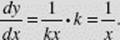
If y = ln (kx), where k is a constant, find 
SOLUTION: We can use both formula (13), and the Chain Rule to get
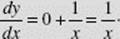
Alternatively, we can rewrite the given function using a property of logarithms: ln (kx) = ln k + ln x. Then
EXAMPLE 21
Given f (u) = u2 − u and u = g(x) = x3 − 5 and F(x) = f (g(x)), evaluate F ′(2).
SOLUTION: F ′(2) = f ′(g(2))g ′(2) = f ′(3) · (12) = 5 · 12 = 60.
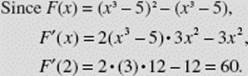
Now, since g ′(x) = 3x2, g ′(2) = 12, and since f ′(u) = 2u − 1, f ′(3) = 5. Of course, we get exactly the same answer as follows.