Discrete Fractional Calculus (2015)
2. Discrete Delta Fractional Calculus and Laplace Transforms
2.8. The Laplace Transform of Fractional Operators
With Corollary 2.66 in hand to insure the correct domain of convergence for the Laplace transform of any fractional operator, we may now safely develop formulas for applying the Laplace transform to fractional operators. This is the content of the next theorem.
Theorem 2.67.
Suppose 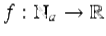 is of exponential order r ≥ 1, and let ν > 0 be given with N − 1 < ν ≤ N. Then for |s + 1| > r,
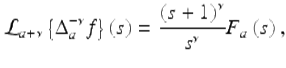
(2.49)
and
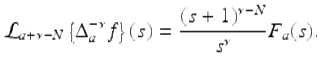
(2.50)
Proof.
Since is of exponential order r ≥ 1, F a (s) exists for | s + 1 | > r and by Corollary 2.66 both 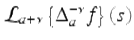 and
and 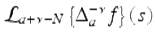 exist for | s + 1 | > r. First, we find a relationship between the left-hand sides of equations (2.49) and (2.50). Using (2.37), we get
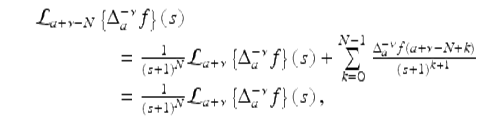
(2.51)
using the fact that  for 0 ≤ k ≤ N − 1, by our convention on sums.
To see that (2.49) holds, note that
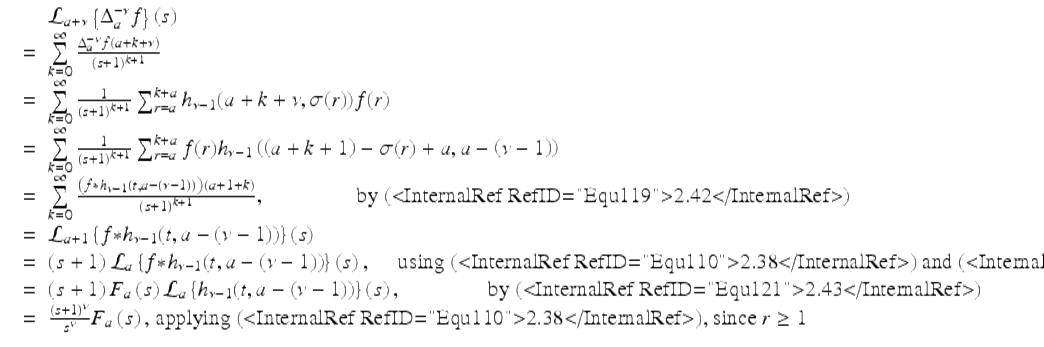
proving (2.49). Finally, using (2.51) and (2.49), we get
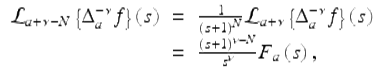
for | s + 1 | > r, proving (2.50). □
Example 2.68.
Find 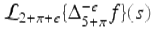 given that

First note that

and hence using (2.39) we have that

for | s + 1 | > 1.
Then using (2.50) gives us
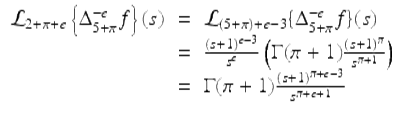
for | s + 1 | > 1.
Remark 2.69.
Note that when ν = N in (2.50), the correct well-known formula (2.46) for N = 1, is obtained. This holds true for the Laplace transform of a fractional difference as well, as the following theorem shows (Holm [123]).
Theorem 2.70.
Suppose is of exponential order r ≥ 1, and let ν > 0 be given with N − 1 < ν ≤ N. Then for |s + 1| > r

(2.52)
Proof.
Let f, r, ν, and N be given as in the statement of the theorem. By Exercise 2.28 we have that (2.52) holds when ν = N. Hence we assume N − 1 < ν < N. To see this, consider
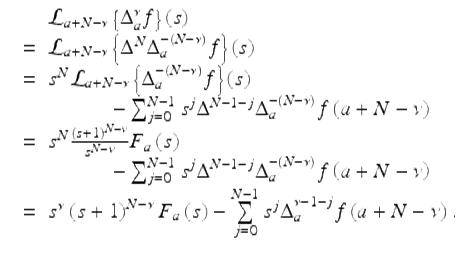
This completes the proof. □