Discrete Fractional Calculus (2015)
3. Nabla Fractional Calculus
3.10. Nabla Laplace Transforms
Having established the necessary preliminaries, we are now ready to discuss an important application of this material: the Laplace transform. The Laplace transform, as in the standard calculus, will provide us with an elegant way to solve initial value problems for a fractional nabla difference equation. In this section, we will lay the groundwork for this method, prove the basic properties, and establish a means in which to solve various initial value (nabla) fractional difference equations. We begin this section by defining the nabla Laplace transform operator  (based at a) as follows:
Definition 3.64.
Assume 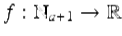 . Then the nabla Laplace transform of f is defined by
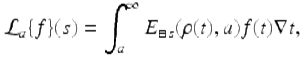
for those values of s ≠ 1 such that this improper integral converges.
In the following theorem we give another formula for the Laplace transform, which is often more convenient to use.
Theorem 3.65.
Assume . Then
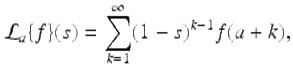
(3.36)
for those values of s such that this infinite series converges.
Proof.
Assume . Then
![$$\displaystyle\begin{array}{rcl} \mathcal{L}_{a}\{f\}(s)& =& \int _{a}^{\infty }E_{ \boxminus s}(\rho (t),a)f(t)\nabla t {}\\ & =& \int _{a}^{\infty }[1 -\boxminus s]^{a-t+1}f(t)\nabla t {}\\ & =& \int _{a}^{\infty }\left ( \frac{1} {1 - s}\right )^{a-t+1}f(t)\nabla t {}\\ & =& \int _{a}^{\infty }(1 - s)^{t-a-1}f(t)\nabla t {}\\ & =& \sum _{t=a+1}^{\infty }(1 - s)^{t-a-1}f(t) {}\\ & =& \sum _{k=1}^{\infty }(1 - s)^{k-1}f(a + k), {}\\ \end{array}$$](fractional.files/image1969.png)
for those values of s such that this infinite series converges. □
In the definition of the nabla Laplace transform we assumed s ≠ 1 because we do not define  . But the formula of the nabla Laplace transform (3.36) is well defined when s = 1. From now on we will always include s = 1 in the domain of convergence for the nabla Laplace transform although in the proofs we will often assume s ≠ 1. In fact the formula (3.36) for any
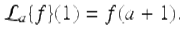
 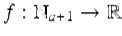 gives us that
Example 3.66.
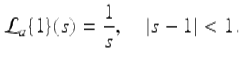
We use the last theorem to find  . By Theorem 3.65 we obtain
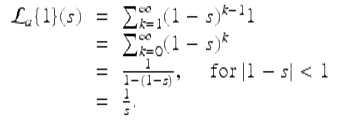
That is
Theorem 3.67.
For all nonnegative integers n, we have that

Proof.
The proof is by induction on n. The result is true for n = 0 by the previous example. Suppose now that 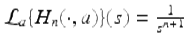 for some fixed n ≥ 0 and | s − 1 | < 1. Then consider

We will apply the first integration by parts formula (3.19) with

It follows that

Hence by the integration by parts formula (3.19)

Using the nabla form of L’Hôpital’s rule (Exercise 3.19) we calculate
![$$\displaystyle\begin{array}{rcl} \lim _{t\rightarrow \infty }\vert (1 - s)^{t-a}H_{ n+1}(t,a)\vert & =& \lim _{t\rightarrow \infty }\frac{H_{n+1}(t,a)} {\vert 1 - s\vert ^{a-t}} {}\\ & =& \lim _{t\rightarrow \infty } \frac{H_{n}(t,a)} {[1 -\vert 1 - s\vert ]\vert 1 - s\vert ^{a-t}} {}\\ & =& \lim _{t\rightarrow \infty } \frac{H_{n-1}(t,a)} {[1 -\vert 1 - s\vert ]^{2}\vert 1 - s\vert ^{a-t}} {}\\ & =& \cdots {}\\ & =& \lim _{t\rightarrow \infty } \frac{H_{0}(t,a)} {[1 -\vert 1 - s\vert ]^{n+1}\vert 1 - s\vert ^{a-t}} {}\\ & =& 0, {}\\ \end{array}$$](fractional.files/image1982.png)
since | s − 1 | < 1. Thus we have that

completing the proof. □
Definition 3.68.
A function is said to be of exponential order r > 0 if there exist a constant M > 0 and a number  such that

Theorem 3.69.
For  , the Taylor monomials H n (t,a) are of exponential order 1 + ε for all ε > 0. Also, H 0 (t,a) is of exponential order 1.
Proof.
Since

H 0(t, a) is of exponential order 1. Next, assume  and ε > 0 is fixed. Using repeated applications of the nabla L’Hôpital’s rule, we get
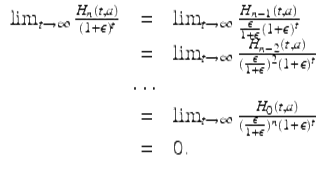
It follows from this that each H n (t, a), , is of exponential order 1 +ε for all ε > 0. □
Theorem 3.70 (Existence of Nabla Laplace Transform).
If is a function of exponential order r > 0, then its Laplace transform exists for  .
.
Proof.
Let f be a function of exponential order r. Then there is a constant M > 0 and a number such that | f(t) | ≤ Mr t for all  . Pick K so that
  , then we have that

We now show that
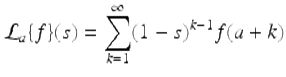
converges for . To see this, consider
![$$\displaystyle\begin{array}{rcl} \sum _{k=K}^{\infty }\vert (1 - s)^{k-1}f(a + k)\vert & =& \sum _{ k=K}^{\infty }\vert 1 - s\vert ^{k-1}\vert f(a + k)\vert {}\\ &\leq & \sum _{k=K}^{\infty }\vert 1 - s\vert ^{k-1}Mr^{a+k} {}\\ & =& Mr^{a+1}\sum _{ k=K}^{\infty }[r\vert s - 1\vert ]^{k-1}, {}\\ \end{array}$$](fractional.files/image1994.png)
which converges since r | s − 1 | < 1. It follows that  converges absolutely for . □
Theorem 3.71.
The Laplace transform of the Taylor monomial, H n (t,a),  , exists for |s − 1| < 1.
Proof.
The proof of this theorem follows from Theorems 3.69 and 3.70. □
Similarly, by Exercise 3.30 each of the functions E p (t, a), Cosh p (t, a), Sinh p (t, a), Cos p (t, a), and Sin p (t, a) is of exponential order | 1 + p | , and hence by Theorem 3.70 their Laplace transforms exist for 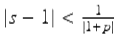 .
.
Theorem 3.72 (Uniqueness Theorem).
Assume 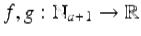 . Then f(t) = g(t),
  if and only if

for some r > 0.
Proof.
Since  is a linear operator it suffices to show that f(t) = 0 for
  if and only if
 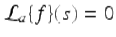 for | s − 1 | < r for some r > 0. If f(t) = 0 for
  , then trivially
 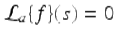 for all
  . Conversely, assume that for | s − 1 | < r for some r > 0. In this case we have that
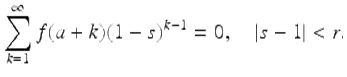
This implies that

This completes the proof. □