University Mathematics Handbook (2015)
III. Analytic Geometry and Vectors
Chapter 6. Straight Line in Space
6.1 Straight Line Equation
The equation of a straight line passing through point 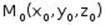 and is parallel to given vector
  is
is
a. In its parametric form
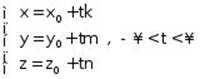
when  is parameter.
b. In its symmetric or canonical form

If one of the numbers  is zero, for instance
  , then the equation is
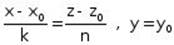
Similarly, canonical forms are obtained if  or
or  .
.
c. In its vector form: 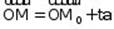 or
or
 ,
,  .
.
6.2 Straight Line as Intersection of Two Planes
Two non-parallel planes intersect in a straight line, and therefore, system of equations
(*) 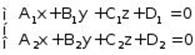 is a straight line equation.
Now we shall see how the canonical equation of the straight line can be obtained from (*):
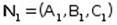 and
and 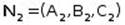 are vectors normal to the given planes respectively. The intersection line of the two planes is on each of them, and is therefore perpendicular to
  ,
,  . Therefore, the direction vector
  of the straight line is
  .
.
A certain solution of the system describes a point on the intersection line of the two planes. That is, we found vector and a point on the strait line, and therefore, the straight line equation can be denoted either in its canonical or parametric form.
Example: Let's get the canonical equation of the given line through planes  .
.
The normal vectors to these planes are  .
.
Let us calculate  .
.
To find a point on the line, we substitute  in the planes equation, the following is resulted from the planes equations
 .
.
Point 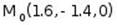 is on the intersection line of the planes, so
 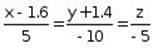 is the intersection line equation.
6.3 Straight Line Passing Through Two Points
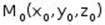 and
and  :
:
Vector  is in the direction of the straight line, so its equation is
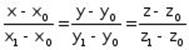
or, in its vector form
 ,
,
6.4 Distance of a Point From a Straight Line
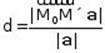
The distance of point  from a straight line passing through point
  and parallel to vector
  is
is
 .
.
6.5 Angle Between Two Straight Lines

The angle between the lines is the angle between vectors and 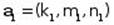 .
.

Two straight lines are perpendicular to each other if, and only if,  , or
, or
 .
.
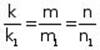
Two straight lines are parallel to each other if, and only if,