University Mathematics Handbook (2015)
IV. Single-Variable Differential Calculus
Chapter 2. Limits of Functions
2.1 Definitions of Limit
a. Heine's Definition of Limit
1. Let function  be defined in the neighborhood of point
  , except, possibly, point
  itself. A real number
  is the limit of when
  if, for all sequence
  converging to limit , such that
  , the sequence
  converges to .
2. Let function , be defined in ray  . A real number is the limit of when
  tends to infinity, if for all sequence converging to infinity, the sequence converges to .
b. Cauchy's Definition of Limit
1. Let function be defined in the neighborhood of point , except, possibly, point itself. is the limit of when ,  , if for every arbitrary small number
  there exists a
  such that for all which holds
 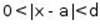 , there holds
  , or, in logic symbols
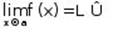
 .
.
2. is the limit of when tends to infinity, if, for an arbitrary small there exists  such that for all holding
  , there holds
  or, in logic symbols
 .
.
c. The limit of at point , is infinity 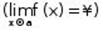 , if for all
  there exists such that for all that holds
  , there holds
  .
.
d. Heine's and Cauchy's definitions are equivalent.
2.2 Properties of Limits
a. Let and  be two functions, and
  ,
,  are their limits. Then:
1.  , for every constant
2. 
3. 
4. 
5. If  , then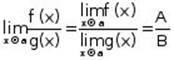
b. If function is bounded and  , then
 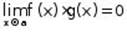 .
.
Example:  and
and  .
.
Therefore, 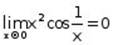 .
.
c. Squeeze (sandwich) theorem: Let ,  ,
,  be three functions defined in a neighborhood of point , except, possibly, point itself. If, for all in this neighborhood, there holds
  and the limits
  exists, then,
  .
.
d. If function has a limit, then it is unique.
e. If there exist two different sequences ,  converging to , but sequences and
  converges to different limit, then, there is no limit for when .
Example: For function  , when
  is the integer value of , there exists no limit when
  .
.
Proof: Let's take the sequence  , holding
  , and, for all
  ,
,  . Therefore,
 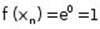 , and therefore
  . Now, let's take the sequence
  . Here,
  . For all ,
  , and
, and 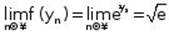 . That is, there doesn't exist a limit
  .
.
f. If is an elementary function, (see, I, 1.9) defined at point  , then
 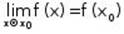 .
.
g.  .
.
h. 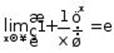 ,
, 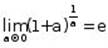 .
.
i. If function is defined in the neighborhood of and there exists a limit  , then:
1. There exists a neighborhood of where is bounded.
2. If  , then there exists a neighborhood of , such that for all in this neighborhood, (except, possibly, ), where there holds
  .
.
3. If  , then there exists a neighborhood of , such that for all in this neighborhood, (except, possibly, ), where there holds
  .
.
2.3 One-Sided Limits
a. Let be a function defined in the right-handed neighborhood of point . That is, let there exist  such that is defined in interval
  . Real number is the right-handed limit of when tends to point to the right
  , (always
  ), if, for every , there exists such that
 .
.
Let's write  .
.
b. Let be a function defined in the left-handed neighborhood of point . That is, let there exist  such that is defined in interval
  . Real number is the left-handed limit of when
  , if for every
  there exists such that holds
  . Let's write
  .
.
Example:  ,
,  .
.
c. For function , there exists a limit at point if, and only if, there exist one-sided limits at this point, and  holds.