University Mathematics Handbook (2015)
VI. Series
Chapter 4. Series of Functions
4.1 Sequences of Functions
a.  is a sequence of functions, and
  is their domain.
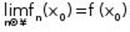
b. The sequence of functions  converges at
  if the sequence
  converges to
  . Written:
c. Set  of all points
  where the sequence of functions converges, is called domain of convergence of the sequence
  .
.
d. For all of set , there is a target value  . All limit values define the function
  ,
,  called limit function.
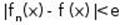
e. The sequence of functions uniformly converges to function in , if for every  , there exists
  (dependent of
  only), such that for all
  and for all , there holds
  .
.
f. Criteria of Uniform Convergence
Cauchy's Criterion: sequence uniformly converges in domain if and only if there exists (dependent of only), such that for all and for all  , and for all integer
  , there holds
  .
.
g. Sequence of functions uniformly converges to in domain if and only if 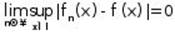 .
.
h. If a sequence of continuous functions in uniformly converges in to , then is continuous in .
4.2 Series of Function
a. Series 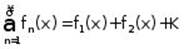 , when is a sequence of factions defined in common domain is a series of functions.
b. At a constant  , the series is a series of numbers
  .
.
c. The set of all points on where the series converges is called the domain of convergence of the series.
d. The sum of the series,  is a function defined in the series domain of convergence, and
 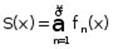 .
.
4.3 Uniform Convergence of Series
a. The series  is uniformly convergent in if the sequence of its partial sums is uniformly convergent in .
b. Cauchy's Criterion: a series is uniformly convergent in if and only if there exists (dependent of  only), such that for every
  for all , for all integer and for all
  , there holds
 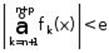 .
.
c. Weierstrass Test: if for series of functions  defined in there exists a positive convergent series
  such that, starting from some
  ,
,  for all
  , then the series is uniformly convergent in .
d. Given series 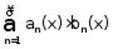 .
.
1. Dirichlet Test: if all partial sums  of the series
  have common bound, that is, there exists
  such that
  for all
  and all , and the sequence
  is monotonic and uniformly convergent to zero at , then the given series is uniformly convergent in .
2. Abel's Test: if the sequence is monotonic and bounded in , and the series is uniformly convergent in , then the given series, also, is uniformly convergent in .
4.4 Continuity, Derivability and Integrability of Sums of Series
a. If functions  are continuous in domain and the series
 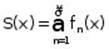 is uniformly convergent in , then function is continuous in .
b. If the sum of a series of continuous functions converges to a discontinuous function in the same domain, then the convergence is not uniform.
c. If is a series of functions continuous in  , and the series of functions
 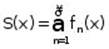 uniformly converges to
  on
on  , then:

d. If functions  are derivable and have continuous derivatives on interval , the series is convergent on
  and series of derivatives
  is uniformly convergent on , then:
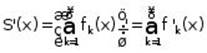
In other words, the derivative of a sum equals the sum of derivatives.
4.5 Power Series and Radius of Convergence
A functional series in the form of 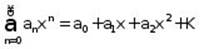 , or
, or  is called a power series.
Substituting  in the latter series, will result in the former series.
a. Radius of Convergence Existence Theorem
For all power series  there exists non-negative
  ,
,  , such that for all
  which holds
  , the series is convergent, and for all which holds
  , the series is divergent, and if
  , the series converges at
  only. If
  , the series converges for all
  . is called the radius of convergence of the series.
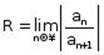
b. Formulas for Calculating the Radius of Convergence
1. 
2. Cauchy-Hadamard formula: 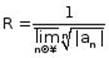
4.6 Uniform Convergence, Derivation and Integration of Power Series
a. If power series with a convergence radius  :
:
1. Diverges at endpoint 
 , then the convergence on interval
  is not uniform.
2. Converges at endpoint , , then the convergence is uniform on intervals  ,
,  .
.
b. The series is uniformly convergent on every segment  , which is entirely within .
c. Sum  of power series with radius of convergence is a function continuous on all
  . If, in addition, it converges on
  , , then is continuous from the left (from the right) at endpoint , .
d. Let be the radius of convergence of a power series 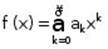 . Then, for all
  , there holds:
1. 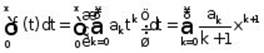 .
.
2. Both series have the same radius of convergence .
3. If a power series converges at , , then, their integrals series also converges at , .
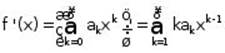
e. If Let be the radius of convergence of a power series. Then, for all , there holds:
1. 
2. The power series and derivatives series have the same power of convergence .
3. If the series of derivatives converges at , , then, the original series converges at the same endpoint.
4.7 Power Series Expansion of Functions
Function defined on is expanded to a power Taylor series, if there exists a power series converging to on .
a. A Necessary Condition of Expansion to Power Series: if is the sum of series on , then is infinitely derivable and all its derivatives are functions contiguous on .
b. The Expansion of to Power (Binomial) Series in Powers of  :
:

converging at 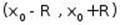 .
.
c. Examples:
1. 
2. 
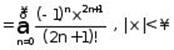
3. 
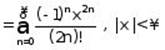
4. 
5. 
6. 
7. 