University Mathematics Handbook (2015)
VII. Differential Calculus of Multivariable Functions
Chapter 3. Limits and Continuity of Functions
3.1 Definition of Limit
a. Cauchy's Definition:  is the limit of function
  at the point
  , if for every
  there exists
  , such that for all
  holding
 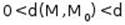 , there holds
 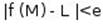 . It is written
 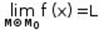 .
.
b. Limit is not dependent of the path through which point tends to  .
.
c. Heine's Definition: is the limit of function  when , if for all sequences of points
  converging to and
  where the function is defined, the sequence
  converges to .
d. Cauchy's and Heine's definition of limit are equivalent.
3.2 Properties of Limit
Let  and
and  be functions defined at the point . If the limits
  exist, then:
a. 
b. 
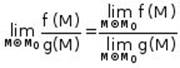
c. If, in addition,  and
and 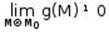 , then:
  .
.
3.3 Continuity at a Point
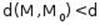
Function  is continuous at point if for every
  there exists such that for all holding
  there holds
  .
.
In other words, function is continuous at  if
if 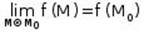 .
.
3.4 Properties of Continuous Functions
a. If function is continuous on  and
and  ,
,  , then there exists a neighborhood of such that at all point of that neighborhood,
  ,
,  .
.
b. If functions  and
and  are continuous on , then:
1. Functions  ,
,  are continuous on .
2. If, in addition,  , then, function
  , is continuous on
  .
.
c. Continuity of a Composite Function
Theorem: Let  be a function defined by
  , and functions
 (*)
(*)
defined by  and let
 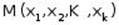 be a point on
  and
and 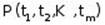 a point on
  , the coordinates of which are connected by (*).
If functions  are continuous on
 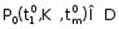 and function
 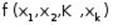 is continuous on
  , such that
 , then, the composite function
  is continuous on
  .
.
In other words, a composition of continuous functions is a continuous function.
d. Function is continuous on domain if it is continuous on all points of .
e. Intermediate Value Theorem: If function is continuous in connected domain , and if points  are on , then, for all real number
  between
  and
and  there exists point
  such that
  .
.
f. Weierstrass Theorem: If function is continuous on closed and bounded domain , then it is bounded on that domain, reaching its maximum and minimum value above . That is, there exist points  ,
,  on , such that:

3.5 Uniform Continuity
a. Function is continuous on domain if, for every there is , dependent on  , such that for all two points
  which hold
 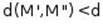 , there holds
  .
.
b. Cantor Theorem: If function is continuous on closed and bounded domain , then it is uniformly continuous on that domain.