University Mathematics Handbook (2015)
VII. Differential Calculus of Multivariable Functions
Chapter 5. Differentiability. Taylor's Formula
5.1 Differentiability of Functions of Two-Variable
a. Function  is differentiable at point
  , if its general addition
  can be represented the following way:

when 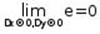 .
.
b. If function is differentiable at point  , then it is continuous at that point.
The inverse proposition is incorrect.
c. If function is defined on the neighborhood of  , and has partial derivatives
  ,
,  continuous in that neighborhood, then it is differentiable at
  .
.
5.2 Differentiability of Function 
a. Let  be an addition to
  ,
, 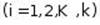 , and let
 be an addition to function at
 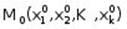 .
.
If addition  can be represented in the following way:
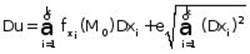
when  , , then function
  is said to be differentiable on .
b. If function 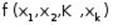 is continuous on , and has partial derivatives continuous in the neighborhood of , then it is differentiable at .
5.3 Differential
a. The linear part of  in relation to is the differential of and is denoted as
  :
:

when  .
.
b. The differential of two-variable function  is
is
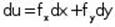
c. Second-order differential:

d. Differential Operator  ,
, 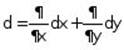 follows the rule:
  .
.
The power of operator  is a binomial, such as:

 -th differential is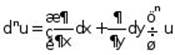
5.4 Taylor's Formula
If function 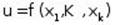 belongs to class
  in the neighborhood of point , then there exists point
  in the interval between and , such that holds

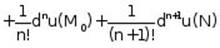
when  .
.
Explicit formula for a 2-variable function:


