University Mathematics Handbook (2015)
II. Functions
Chapter 3. Parametric Form of a Function
In the explicit form of function  , variables
  and
and  relate directly.
But in its parametric representation, and relate indirectly. In this case, variables  and are dependent of another variable,
  , as presented by the two equations
  ,
,  , in a given domain for variable . Variable is called the parameter of the form. If function
  is invertible above the given domain, then it can be denoted as
  , and be denoted in the explicit form of the function
  .
.
Geometrical Interpretation
If parameter is regarded as time variable, then equations  , describe point
  in a plane, where particle is situated at time . Therefore, the plain curve consisting of all points
  represents the trajectory of particle in a plane.
Examples:
a.  ,
,  ,
,  is a parametric representation of an upper semicircle, the explicit form of which is
 . If also the domain of is extended to interval
  , the result will be full circle
  , which is not a graph of a function.
b.  .
.  , is a parametric form of a function. The function
  is invertible in interval
  . Then to directly relate between and , we extract from the former equation. The result is
  . Positioning it in the latter equation, we get
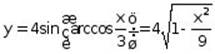
Another way of finding it here is using the trigonometric identity
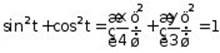 .
.
The result is  , since
  for all in its domain , it is the upper half of the aforementioned ellipse
  .
.
c.  ,
,  is a parametric form of function
  , since
  , and therefore
 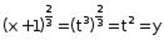 .
.