University Mathematics Handbook (2015)
IX. Vector Analysis
Chapter 10. Surface Integral
10.1 Surfaces

a.  is a smooth surface if vector function
  is of class
  region.
b. The unit normal to surface  is
is 
c. A smooth surface S is called oriented (two-sided) if there is a normal unit vector n at every point on S, not on the boundary curve of S, such that n is a continuous function of (x, y, z) on S. Later on, each surface must be oriented, have a finite area and a single smooth, closed boundary curve. The sphere, ellipsoid, paraboloid, and hyperboloid are two-sided surfaces.
A nonorientable surface is, for example, a Mobius strip. It is formed by half-twisting a strip of paper, attaching its ends together (see illustration). If we draw a unit normal N from one point of a Mobius strip, we eventually get a normal at the same point, at the opposite direction of the original normal.
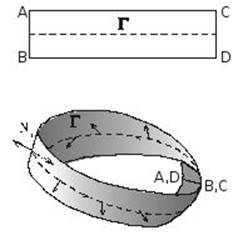
d. A smooth surface is two-sided if the direction of normal can on it can be specified definitely. Later on, we shall only refer to two-sided surfaces.
e. The area of the surface is 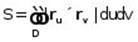 .
.
f. If surface is given in the form  , then its area is
 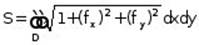 .
.
g. The positive direction of surface is the direction of normal  . If
. If  is the boundary of a closed body, then the positive direction on is outwards. If is an open surface, then the positive direction is towards the Z-axis.
10.2 Surface Integral
Given a vector field

a.  is a surface integral when
  is the unit normal vector to surface .
b. Different ways of writing and calculating surface integral:


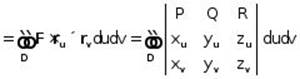
when  are directional angles of .
c. Gauss Divergent Theorem
Let  be a body the boundary of which is smooth and closed surface with an outer normal . If vector field
 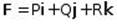 is of class in , then holds
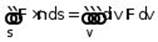
or  .
.
The integral is called the flux of vector field  through surface .
d. Stokes Theorem
If, in the neighborhood of two-sided surface , vector field 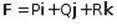 is of class and
  is the boundary of surface in the positive direction, then
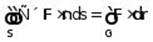 or
or 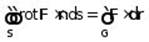
denote