University Mathematics Handbook (2015)
X. Algebra
Chapter 6. Determinants
6.1 Second-Order and Third-Order Determinants
a. 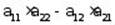 is called second-order determinant of matrix
 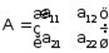 and is denoted

b. The third order determinant of the matrix is the number:

6.2 Permutations and  -th Order Determinant
a. The arrangement  of integers
  is called permutation.
b. All  permutations of is denoted
  .
.
c. Let  be a permutation in . A disorder in is a pair of integers
 , when
  , but
, but  precedes
  in .
in .
d. is an even permutation, if the number of disorders is even. On the other hand, it is an odd permutation if the number of disorders is odd. The sign of is denoted by  .
.
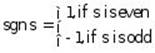
e. Switching the places of two elements in a permutation changes the evenness (or oddness).
f. For every square matrix  the determinant is:

when the sum includes all permutations of numbers .
In other words: The determinant of matrix  is the sum of elements in the form of
  every one of which has a single representative of each row and each column with the corresponding sign.
g. Scalar  , called the cofactor
  of matrix is an
  -th order determinant of a matrix resulted from eliminating row
  and column
  of matrix .
h. Expansion by row  : The determinant of -th order square matrix equals to
 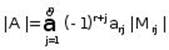 .
.
6.3 Properties of Determinants
a. A determinant of upper or lower triangular or diagonal matrix equals to the product of diagonal elements.
b. If all elements in a row (column) of a matrix are zeroes, then its determinant equals zero.
c. If -th order matrices  are only different by the elements of row , that is,
  ,
,  ,
,  , and
, and  , then
  .
.
d. If matrix  is obtained from matrix , by multiplying all the elements of just one row by an
  , then
  .
.
e. The determinant of a matrix which has two equal rows, equals zero.
f. If two rows in a matrix are proportionate, then its determinant equals zero.
g. A determinant does not change if all the elements of one row are added corresponding elements of another row multiplied by a non-zero constant.
h. A determinant of a multiplication of matrices is equal to the multiplication of their determinants:

i.  .
.
j. If  , then
  .
.
6.4 Inversion of Matrices and Determinants
a. Matrix s invertible, if and only if  .
.
b. If is invertible, then  .
.
c. If matrix  is invertible, then
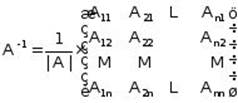
when 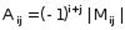 is the algebraic cofactor of element and
  is a cofactor corresponding to (see 6.2.g).