University Mathematics Handbook (2015)
III. Analytic Geometry and Vectors
Chapter 1. Coordinate Systems in the Plane
1.1 Cartesian Coordinate System in a Plane
A Cartesian coordinate system consists of two number lines perpendicular to each other, where the horizontal is  and the vertical is
  , intersecting at a point called the origin, and dividing the plane into four quarters. See Figure 1.
Each point  in the plane is specified by an ordered pair of numbers
  , where “
 ” stands for the distance of from the -axis, and marked with
  (plus) if is right of the -axis, or with
  (minus) if s left of the -axis. “
 ” is the distance of from
  -axis, and is marked with (plus) if is above the -axis, or with (minus) if is below the -axis. Thus, pair is the coordinates of point .
Figure 1 shows the coordinates of  ,
,  ,
,  , and
, and  .
.
1.2 Polar Coordinate System
Let's fix point  in the plane, called a pole, and a ray
  . The position of point in the plane is strictly defined by its distance
  from pole and the positive angle
  between vector
  and axis
  , when taken from to, counterclockwise.
The pair  are called the polar coordinates of point .
All points in the plane have a unique pair of polar coordinates. Where and  , Pole is represented by
  and any angle , which means the pole is not uniquely represented.
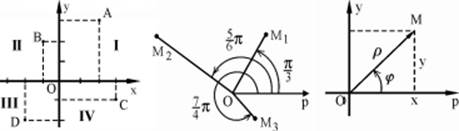
Figure 1 Figure 2 Figure 3
The polar coordinates of the points in Figure 2 are:

1.3 Relation Between Cartesian and Polar Coordinates
Fixing Pole at the origin of Cartesian system, and axis on its -axis, we get the relations between the two coordinate systems (Figure 3).

And, vice versa, if and are known, the result should be

1.4 Distance Between Two Points 

1.5 Area of a Triangle with Vertices


