University Mathematics Handbook (2015)
XII. Complex Functions
Chapter 7. Isolated Singular Point
7.1 Definitions
a. Singular point  of
of  is an isolated singular point of
  if there exists a ring
 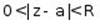 (small enough), where is analytic, and therefore can be expanded to Laurent series:
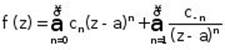 (*)
(*)
b. The second sum of (*) is called the principal part of .
c. In (*), one can notice three distinct cases:
1. A Laurent series not including its principal part, that is 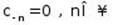
2. A principal part with a finite number of terms.
3. A principal part with an infinite number of terms.
7.2 Removable Singular Point
a. If, in an expansion of Laurent series (*) the coefficients are  , then point is a removable singular point.
b. Point is a removable singular point of function if and only if there exists a finite limit  .
.
c. Example:  is a removable singular point of function
  .
.
7.3 Pole
a. If the principal part of a Laurent series contains a finite number of terms, 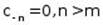 and
and  , then
 .
.
In this case, is called a pole of order  of .
of .
b. If  then is a simple pole or just a pole of .
c. is a pole of order if and only if can be represented in the form of 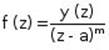 where
where  is analytic in the neighborhood of
  and
and  .
.
d. is a pole of order of function if and only if is a zero of order of function  .
.
7.4 Essential Singularity
a. If the principal part of an expansion of function to a Laurent series has an infinite number of terms, then is called essential singular point of .
b. Picard theorem: An analytic function in a perforated neighborhood of an isolated essential singular point attains (an infinite number of times) any finite value except, perhaps, one singe value. In other words, if is an isolated essential singular point of function then, for every finite  , except perhaps one single value, equation
  has an infinite number of solutions tending to
  .
.