Most beautiful small birds - Sykalo Eugen 2024
Eurasian Coal Tit (Periparus ater)
Identification:
- Species name: Eurasian Coal Tit, Black-capped Tit
- Scientific name: Periparus ater
- Family: Paridae (Tits and Chickadees)
- Order: Passeriformes (Songbirds)
- Subclass: Neornithes (Modern birds)
- Class: Aves (Birds)
Oh, my goodness, have you ever just stopped, truly stopped, and let your gaze snag on one of nature's tiniest, most vibrant masterpieces? Because if you haven't, then let me introduce you to a creature that, for me, embodies the very essence of a forest's hush and a mountain's whisper, all wrapped up in a bundle of pure, unadulterated pluck: the Eurasian Coal Tit (Periparus ater). Just saying its name makes me smile, a little flutter of excitement! It's not a flashy tropical parrot, no, no, not at all. But this little dynamo, this tiny powerhouse of avian charm, is a true superstar in its own right. Imagine a miniature knight, clad in the sleekest, most sophisticated armor of slate grey and creamy white, always ready for a new adventure. It's got this distinctive white patch on the back of its neck, like a tiny, gleaming badge of honor, and a sharp, almost mischievous black cap that gives it an air of intelligent curiosity. Its song? Oh, its song! It’s like a tiny, insistent bell, a rapid-fire “wit-chee, wit-chee, wit-chee” that’s as characteristic of ancient pine forests as the scent of resin and damp earth. You hear it, and you just know you’re in its vibrant world. It's an invitation, a secret handshake into the hidden life of the woods.
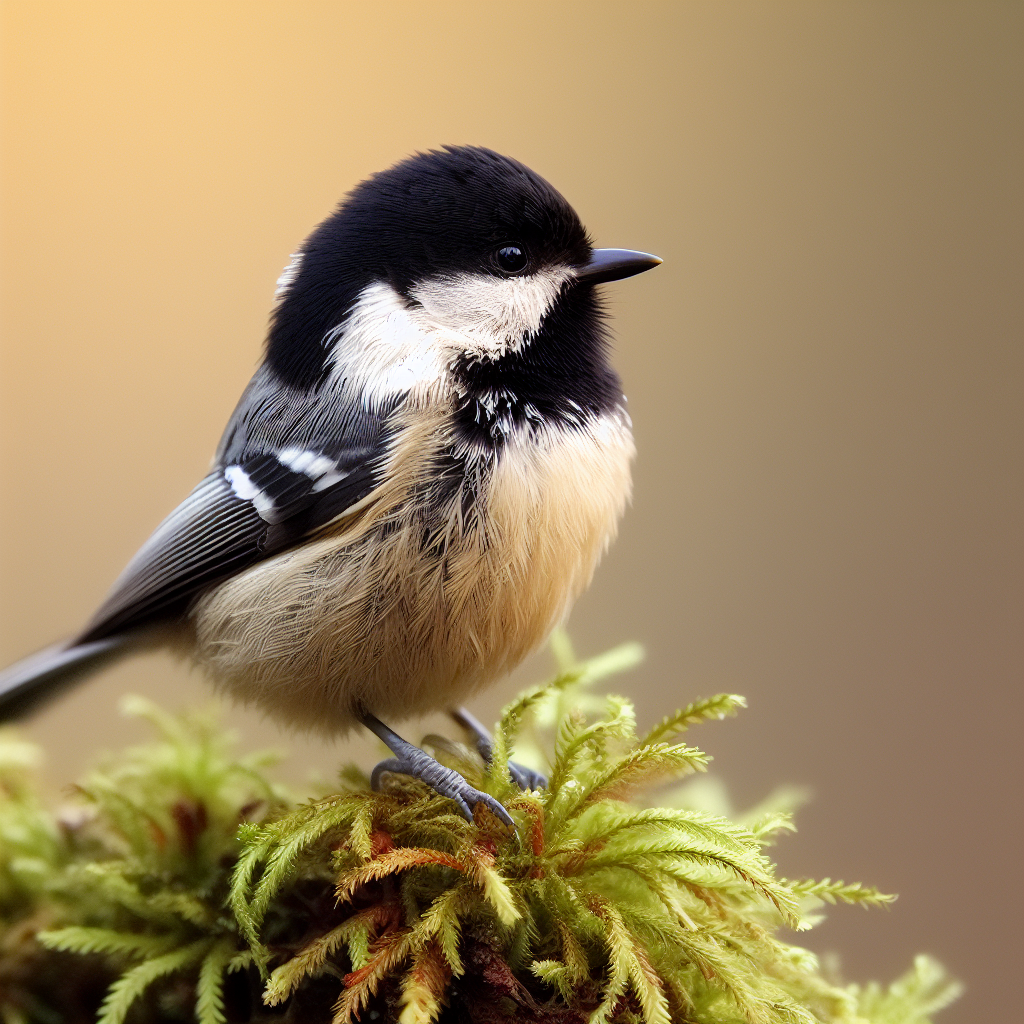
And let's talk about that plumage, shall we? It’s not just pretty; it’s practically a work of functional art! The Eurasian Coal Tit is a masterclass in understated elegance. Its back and wings are this gorgeous, soft slate grey, blending seamlessly with the shadows and bark textures of its beloved conifers. Then, BAM! You get the stark, contrasting white cheeks, framing those bright, bead-like eyes, and that glossy black cap, extending down the throat like a sleek cowl. It’s like a tiny, feathered ninja, always ready for a quick dart or a silent observation. You won’t find much difference between the males and females — they’re both equally stunning, which I find rather egalitarian, don't you? This uniform coloration isn't just for show, though. It’s a brilliant camouflage, allowing them to flit almost invisibly through the dense needle-laden branches, snatching up an unsuspecting insect or a hidden seed. And their size! Imagine holding a thimble in your hand; that’s roughly the scale we’re talking about. On average, they measure a mere 10-11.5 cm (about 4-4.5 inches) from beak to tail tip, with a wingspan that barely stretches beyond 17-21 cm (6.7-8.3 inches). And their weight? A featherlight 7-12 grams (0.25-0.42 ounces)! These minuscule dimensions aren't a hindrance; they're an advantage. Their small size allows them to navigate the tightest arboreal spaces, to cling to the thinnest twigs, and to extract tiny morsels from cracks and crevices that larger birds could never reach. Their beaks are needle-sharp and perfectly adapted for picking out seeds from cones or gleaning insects from bark. Their little legs and feet are like tiny, powerful grappling hooks, allowing them to hang upside down with astonishing ease, performing acrobatic feats that would make a gymnast blush. Honestly, they’re like tiny, feathered superheroes, masters of miniaturization and aerial agility!
Now, where do these enchanting little sprites call home? Well, the Eurasian Coal Tit is a true child of the forest, with a particular soft spot for coniferous woodlands. Think sprawling pine forests, dense spruce plantations, and even mixed woodlands where conifers stand tall among deciduous trees. They’re adaptable, though, these little survivors! You might even spot them in parks and gardens, especially if there are mature trees around. They occupy a fascinating ecological niche, often foraging higher up in the canopy than some of their tit cousins, meticulously gleaning insects and seeds from the needles and cones. Their geographic range is, dare I say, epic! They’re found right across Europe, from the UK and Scandinavia all the way to Siberia and even parts of North Africa and Asia. It's a testament to their resilience and adaptability, isn't it? They’ve carved out a life for themselves in so many diverse landscapes. And their specific preferences for dwelling places? They truly thrive in the deep, quiet places of old-growth forests, where the trees are ancient, and the undergrowth provides a rich tapestry of life. This preference for mature forests also impacts their interactions with other species. They might not be the flashiest predators, but they play a crucial role in regulating insect populations, and their calls often serve as a delightful backdrop to the symphony of the forest, a constant, cheerful presence amidst the rustling leaves and the whispering winds. It’s a profound interconnectedness, truly.
And what about their daily lives? Oh, the things they get up to! When it comes to dining, the Eurasian Coal Tit is a bit of an omnivore, but with a serious penchant for insect protein during the breeding season. They’re insectivores extraordinaire, gleaning caterpillars, beetles, and spiders from the foliage with almost surgical precision. But as autumn rolls in and winter approaches, they pivot to a more plant-based diet, becoming champion seed-eaters, particularly fond of the bounty hidden within conifer cones. Have you ever seen a bird extracting a tiny seed from a pine cone? It's like watching a master locksmith at work, delicate and precise. And they’re clever little hoarders! They’ll often cache seeds and insects in bark crevices or under moss, remembering their hidden stashes later — a vital survival strategy for those lean winter months. It's like they're preparing for a tiny, feathered apocalypse, and they do it with such efficiency!
Their vocalizations? Pure poetry! The typical song, as I mentioned, is that rapid-fire, almost anxious-sounding “wit-chee, wit-chee, wit-chee” or “pee-chew, pee-chew, pee-chew” repeated over and over. It’s a high-pitched, insistent call that carries surprisingly far through the dense forest. Is it a declaration of territory? An advertisement for a mate? Perhaps a little bit of both, a tiny, urgent bulletin board message broadcast across the arboreal airwaves. And you know what’s funny? Sometimes, when I hear it, I imagine them gossiping about the latest squirrel shenanigans or debating the best sun-drenched branch for a nap. What secrets do those little calls truly hold? We can only wonder!
Now, let's talk about family life. They’re meticulous nest builders, these little ones! They prefer to nest in tree cavities, often old woodpecker holes, but they're not above getting creative and using a hole in a wall or even a forgotten teacup if the circumstances are right. The female does most of the construction, creating a cozy cup-shaped nest from moss, lichen, wool, and feathers. It’s like a miniature, perfectly insulated nursery, ready for the miracle of new life. She’ll lay a clutch of 7-11 eggs, tiny pearls speckled with reddish-brown, and then she’ll incubate them for about 14-16 days. The male, being a good partner, will often bring her food during this time. Once the chicks hatch, they’re utterly helpless, tiny bundles of fluff and gaping mouths, but they grow astonishingly fast! Both parents work tirelessly to feed them, making countless trips back and forth with insects. The fledglings leave the nest after about 18-20 days, but they’re still dependent on their parents for a short while, learning the ropes of foraging and surviving. It’s a whirlwind of activity, a true testament to the dedication of these tiny parents.
Are they migratory? This is where it gets a little nuanced, like many good stories. Eurasian Coal Tits are largely resident throughout much of their range, meaning they stick around their breeding grounds year-round. However, in some northern and eastern parts of their range, or during particularly harsh winters when food is scarce, they can undertake irruptive movements, meaning large numbers of them might suddenly move to new areas in search of food. It's not a grand, organized migration like some other birds, but more like an exciting, spontaneous adventure driven by necessity and the call of the wild. It’s the kind of spontaneous road trip I always wish I could take!
And their social structure? While they can be seen foraging alone or in pairs during the breeding season, come winter, they often join mixed-species foraging flocks, especially with other tit species. It’s like a tiny, feathered networking event, a winter survival club where many eyes are better than two for spotting predators or finding food. There’s a certain charming camaraderie in these flocks, a collective vigilance that’s truly heartwarming to witness.
Now for a truly astounding fact, a little nugget of information that just makes my jaw drop! You know how I mentioned their amazing memory for cached food? Well, studies have shown that the Eurasian Coal Tit has a remarkably advanced spatial memory, allowing it to remember the locations of hundreds, if not thousands, of hidden seeds. It's not just a good memory; it's an incredible cognitive feat, a little feathered supercomputer with a built-in GPS! It’s like they have a photographic memory for every tiny crevice and every perfectly placed seed. One time, I swear, I was watching a Coal Tit frantically burying a seed, and then it paused, looked right at me, and I had this absurd thought that it was thinking, "Don't even think about it, human!" Such a tiny bird, such immense intellect!
And their interaction with us? They're generally not a synanthropic species in the way pigeons or house sparrows are, meaning they don't rely on human habitation. But they are frequent visitors to garden feeders, especially in winter, where their bright-eyed presence brings such joy. Their role in the ecosystem is subtle but vital: they're insect controllers, seed dispersers, and a delightful part of the forest's biodiversity. Human activity, particularly deforestation and habitat fragmentation, can certainly impact them. But here’s the hopeful part: while they’re not currently listed as endangered, maintaining healthy, diverse forest ecosystems is key to their continued thriving. Every effort to plant trees, to protect old-growth forests, to create green corridors, benefits not just the Eurasian Coal Tit but the entire tapestry of life that depends on these crucial habitats. It's a reminder that every action, no matter how small, can contribute to a brighter, more vibrant future for all living things. We can all be guardians of these tiny wonders!
So, as we say goodbye to our little Eurasian Coal Tit for now, remember this: in a world that often rushes past the small and the unassuming, there exists a creature of profound beauty and resilience, a tiny embodiment of the forest’s quiet magic. It’s a reminder that true wonder isn’t always found in the grandest gestures but often in the meticulous details, the vibrant energy, and the sheer, unyielding spirit of a small bird with a mighty heart. Next time you’re in a woodland, listen closely. You might just hear that insistent “wit-chee, wit-chee, wit-chee,” a tiny invitation to slow down, to observe, and to fall completely, utterly in love with the endless, joyful spectacle of the natural world. Go on, embrace the wonder! You never know what tiny, vibrant superhero you might discover next!