Most beautiful small birds - Sykalo Eugen 2024
Red-crested Cardinal (Paroaria coronata)
Identification:
- Species name: Red-crested Cardinal (sometimes called Argentine Cardinal)
- Scientific name: Paroaria coronata
- Family: Thraupidae (Tanagers)
- Order: Passeriformes (Songbirds)
- Subclass: Neornithes (Modern birds)
- Class: Aves (Birds)
Oh, my goodness, have you ever just stopped in your tracks, caught by a flash of absolute, unadulterated brilliance? Because I have, countless times, and usually, it involves feathers! There’s a certain magic in the world, and it often wears a crown. And when that crown is a fiery, impossible crimson, perched atop a creature of sleek, elegant charcoal and snowy white, you know you’ve stumbled upon something truly special. Friends, let me introduce you to the Red-crested Cardinal, Paroaria coronata — a bird so captivating, it feels like it flew straight out of a dream and landed right here on Earth to show us how much joy can be packed into a tiny, feathered package!
Seriously, it’s not just a bird; it’s a living jewel, a tiny rockstar in a world of subtle greens and browns. Imagine this: a head the color of a perfect, sun-kissed strawberry, so vivid it almost hums. That’s its signature, its flamboyant declaration to the world, a fiery crown atop a sleek, dark gray cape that flows down its back. And then, a startlingly pure white chest and belly, as if it’s wearing the finest white linen. It’s a study in contrasts, a masterpiece of natural design! You’ll often spot them near water, flitting through gallery forests or open woodlands, their song a surprisingly sweet and clear whistle, a melodic invitation to step into their vibrant world. It's not just a song; it's a serenade, a little aria performed for the sheer joy of existence.
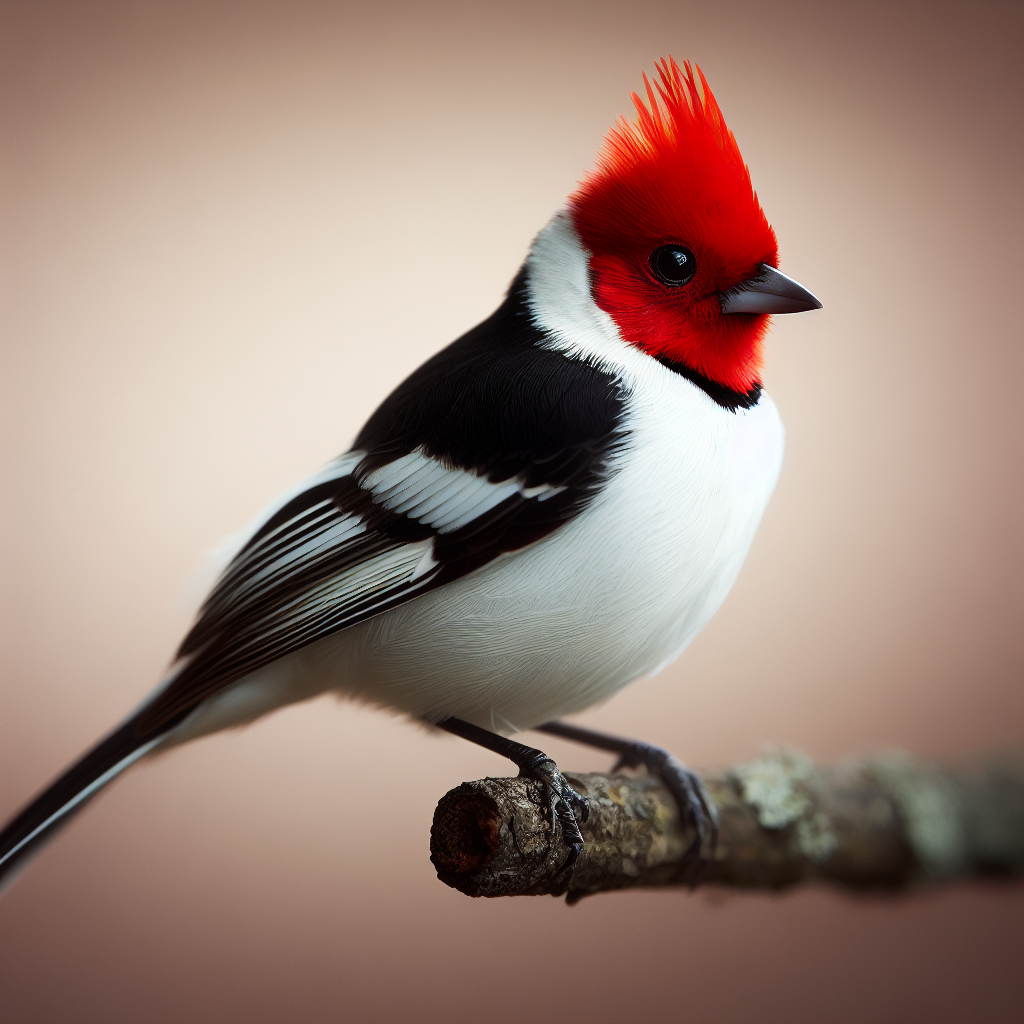
Now, let's talk about the incredible artistry of its design, because honestly, the Red-crested Cardinal is like a biological superhero with the most stylish costume! That spectacular plumage isn't just for show (though it certainly is a show!). That vibrant crimson head, equally brilliant on both males and females, acts as a visual amplifier, a beacon in the dappled light of their habitat. It likely plays a role in attracting mates, a "Look at me, I'm fabulous and healthy!" signal that just screams vitality. Their backs are a sophisticated slate-gray, a subtle blend that allows them to melt into the shadows when needed, a true cloak of invisibility when they’re not showing off their fiery crowns. And that crisp white underbelly? It's like a built-in air conditioner, reflecting sunlight and helping them stay cool in their often sun-drenched environments.
These feathered marvels typically measure in at a tidy 18-19 cm (about 7.1-7.5 inches) in length, with a wingspan that’s surprisingly substantial for their size, letting them zip through the air with effortless grace. They weigh a mere 25-30 grams (less than an ounce!), a feather-light package packed with so much life! Their size, I’ve always thought, gives them this fantastic agility. They’re not bulky, they’re nimble, darting through branches with the precision of a seasoned acrobat. Their beak? It's a stout, conical tool, perfectly shaped for crushing seeds with incredible efficiency — a true precision instrument. Their legs are strong and dark, designed for perching and hopping, giving them the perfect balance whether they’re swaying on a slender branch or exploring the ground for a tasty morsel. And that tail, oh, that tail! It’s moderately long and slightly forked, a rudder for aerial maneuvers, a subtle extension of their elegant form. It's like they were engineered by a master craftsman, every curve, every color, serving a purpose in their spectacular lives.
And where do these dazzling creatures call home? Well, the Red-crested Cardinal is a true South American superstar! They’re found primarily in the southern parts of Brazil, through Paraguay, Uruguay, and into central Argentina. They’ve also been introduced to places like Hawaii and Puerto Rico, and honestly, who can blame anyone for wanting these beauties around? They absolutely thrive in semi-open habitats, often preferring areas near water — think riversides, lagoons, and even urban parks and gardens where there’s a good mix of trees, shrubs, and open ground. They’re not deep forest dwellers; they like a bit of breathing room, a place to show off their vibrant plumage. They’re perfectly adapted to these mosaic landscapes, flitting from tree to bush, always with an eye on the water's edge, a vital resource in their world. It’s truly a testament to nature's incredible adaptability, how a creature can carve out its perfect niche and flourish, turning diverse landscapes into their own vibrant kingdoms!
Now, let’s get into the nitty-gritty of their daily lives, because their behavior is just as fascinating as their looks! Their diet is primarily granivorous, meaning they’re big fans of seeds — think of them as nature’s little seed-dispersing superheroes! But they’re not exclusive; they’ll also happily munch on fruits and insects, especially during breeding season when extra protein is a must for growing chicks. They’re often seen foraging on the ground, hopping with a charming earnestness, meticulously sifting through leaf litter, or picking seeds directly from plants. It’s like watching a tiny, feathered gourmet chef, carefully selecting the finest ingredients for their next meal.
And their voice! Oh, their vocalizations are pure joy. Their typical song is a series of clear, whistling notes, sometimes described as a "wee-tew-wee-tew" or "cheer-up-cheer-up" kind of sound. It’s a bright, cheerful melody that just makes you want to smile. It’s their way of communicating, of declaring their territory, of attracting a mate. But sometimes, when I hear them, I can’t help but wonder: are they just singing for the sheer delight of it? Are they composing little spontaneous jazz solos on the morning dew, just for the sheer joy of being alive? It makes you wonder, doesn’t it?
When it comes to raising a family, Red-crested Cardinals are wonderfully dedicated. They typically build their nests in shrubs or low trees, usually no more than a few meters off the ground. The nest itself is a neat, cup-shaped structure, crafted from twigs, grasses, and rootlets, often lined with softer materials like fine fibers or animal hair. They’re master architects, creating a cozy cradle for their future offspring. The female usually lays 2-3 eggs, a lovely greenish-white or pale blue, speckled with brown. Incubation lasts about 11-13 days, a period of quiet anticipation, and then, tiny, hungry chicks emerge! Both parents are involved in feeding the young, a constant shuttle service of insects and seeds, ensuring their little ones grow strong. The chicks fledge, or leave the nest, in about 10-14 days, a remarkably fast development, ready to take on the world with their own little bursts of crimson and white.
Are they travelers? Mostly, our Red-crested Cardinals are resident birds, meaning they stick around their home territories year-round, enjoying the consistent warmth of their South American homes. They don't embark on those epic, continent-spanning migrations like some of their avian cousins. Instead, they’re creatures of their chosen landscapes, forming stable populations and becoming familiar, welcome sights in their preferred haunts. But even within their resident status, there can be local movements, small wanderings in search of better food sources or new territories. It’s less of a grand adventure and more of a delightful exploration of their immediate world.
Socially, they often move in pairs or small family groups, though you might sometimes see them in slightly larger flocks, especially outside the breeding season. They’re generally not aggressive, coexisting fairly peaceably with other species. While they defend their nesting territories during breeding, they’re not the most fiercely territorial birds. It’s more about a polite "this is our space, please respect it" than an all-out war. They’re a testament to the beauty of social harmony in the avian world.
Now for some truly mind-blowing facts! One of the most astounding things about the Red-crested Cardinal is its remarkable adaptability to human-modified landscapes. They’re not shy about making a home in urban parks, gardens, and even agricultural areas, as long as there’s some suitable vegetation and, crucially, access to water. This makes them what we call a "synanthropic" species — they actually benefit from human presence to some extent! It’s like they looked at our cities and said, "Hey, nice places you've built! Mind if we move in?" And honestly, who wouldn’t want these living sparks of joy gracing their backyard? I once saw a Red-crested Cardinal perched on a bicycle handlebar in a park, bold as brass, as if it owned the place! It winked at me, I swear it did, right before it darted off to snatch a fallen seed. It was a moment that perfectly encapsulated their charming blend of wildness and urban savvy.
When it comes to conservation, the good news is that the Red-crested Cardinal is currently listed as "Least Concern" by the IUCN. Their populations are stable, and their ability to adapt to varied habitats, including those impacted by human activity, has helped them thrive. This is truly cause for celebration! They’re a beautiful reminder that with a little care and understanding, we can share our world with these magnificent creatures. Preserving their habitat, ensuring access to clean water, and simply appreciating their presence are all ways we can continue to support these vibrant birds. Every garden planted with native seeds, every respectful moment spent observing them, contributes to their ongoing success. It's a reminder that even the smallest actions can help keep the world a vibrant, feathered place!
So, the next time you hear a sweet, clear whistle near a patch of green, or catch a flash of impossible crimson in your periphery, let your heart do a little happy dance. That’s the Red-crested Cardinal, a tiny, feathered ambassador of pure, unadulterated joy, reminding us that beauty, resilience, and a touch of flamboyant brilliance are all around us, waiting to be discovered. It’s not just a bird; it’s a living poem, a burst of color against the canvas of the everyday, and a gentle whisper that the world, with all its wild wonders, is an astonishingly vibrant place. Now go on, let that thought fill you with sunshine!