Calculus AB and Calculus BC
CHAPTER 5 Antidifferentiation
B. BASIC FORMULAS
Familiarity with the following fundamental integration formulas is essential.
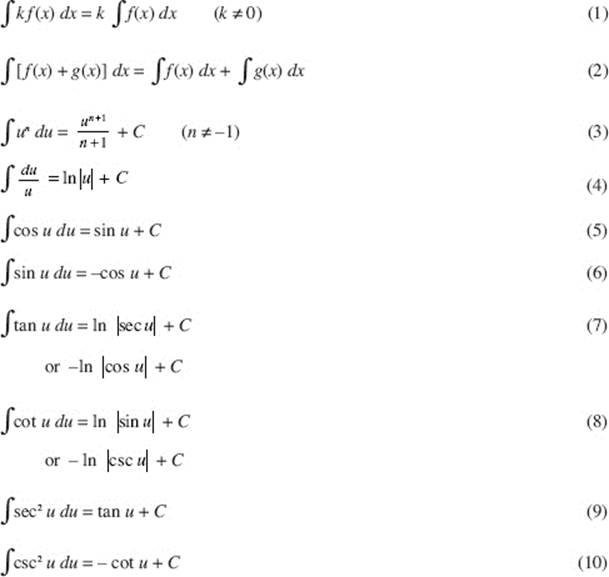
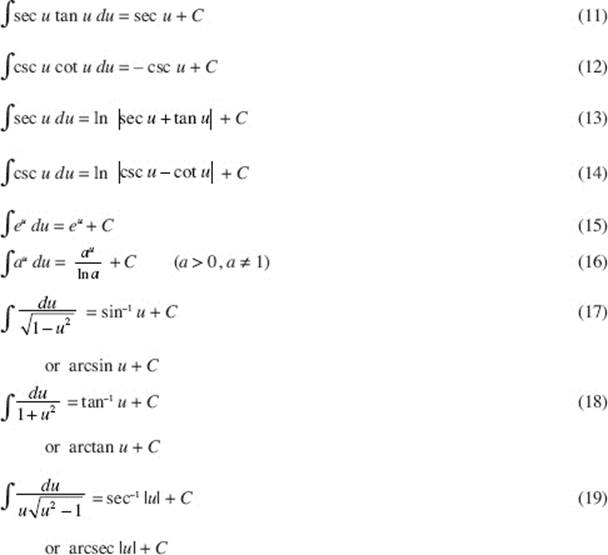
All the references in the following set of examples are to the preceding basic formulas. In all of these, whenever u is a function of x, we define du to be u ′(x) dx; when u is a function of t, we define du to be u ′(t) dt; and so on.
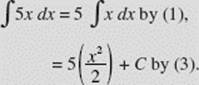
EXAMPLE 1
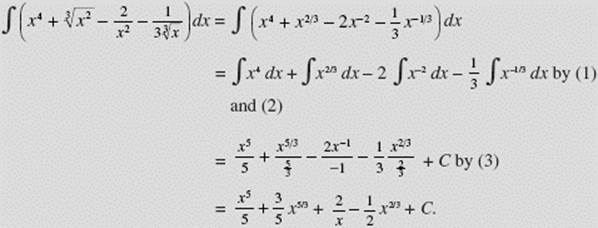
EXAMPLE 2
EXAMPLE 3
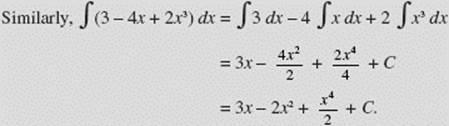
EXAMPLE 4
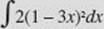 is integrated most efficiently by using formula (3) with u = 1 − 3x and du = u ′(x)dx = −3 dx.
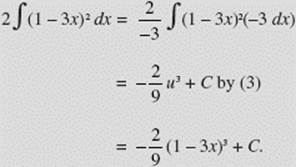
EXAMPLE 5
 where u = 2x3 − 1 and du = u ′(x) dx = 6x2 dx; this, by formula (3), equals

EXAMPLE 6
 du, where u = 1 − x and du = −1 dx; this, by formula (3) yields
EXAMPLE 7

EXAMPLE 8

EXAMPLE 9

EXAMPLE 10
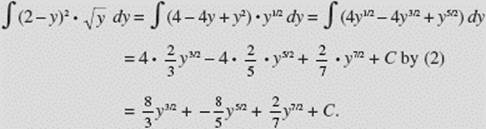
EXAMPLE 11

EXAMPLE 12
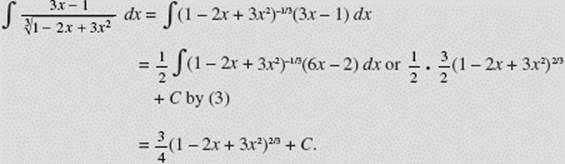
EXAMPLE 13

If the degree of the numerator of a rational function is not less than that of the denominator, divide until a remainder of lower degree is obtained.
EXAMPLE 14

EXAMPLE 15

EXAMPLE 16
 with u = 5 + 2 sin x. The absolute-value sign is not necessary here since (5 + 2 sin x) > 0 for all x.
EXAMPLE 17

EXAMPLE 18
 (by long division) = −x − ln |1 − x| + C.
EXAMPLE 19

EXAMPLE 20

EXAMPLE 21

EXAMPLE 22

EXAMPLE 23

EXAMPLE 24

EXAMPLE 25
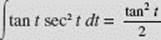 + C by (3) with u = tan t and du = u ′(t) dt = sec2 t dt.
EXAMPLE 26
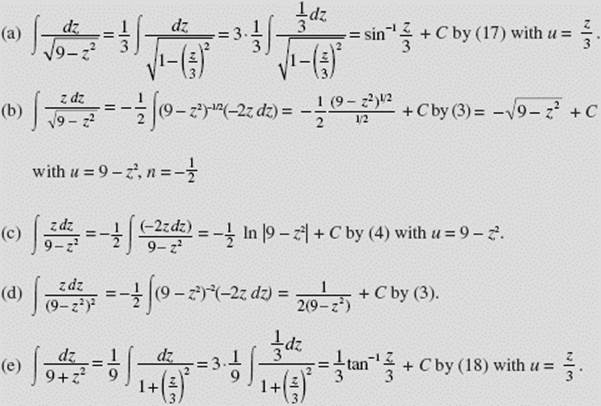
EXAMPLE 27
 by (4)
with u = 1 + 2 and
and 
EXAMPLE 28

with u = cos x;  cos 2x + C by (6), where we use the trigonometric identity sin 2x = 2 sin x cos x.
EXAMPLE 29

EXAMPLE 30
 using the trigonometric identity
EXAMPLE 31

EXAMPLE 32
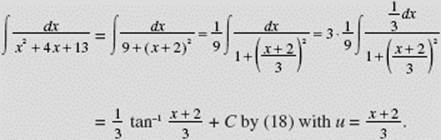
EXAMPLE 33
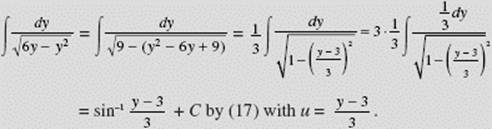
EXAMPLE 34
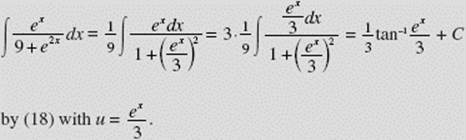
EXAMPLE 35

EXAMPLE 36

EXAMPLE 37

EXAMPLE 38
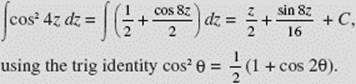
EXAMPLE 39

EXAMPLE 40

EXAMPLE 41

BC ONLY