Discrete Fractional Calculus (2015)
2. Discrete Delta Fractional Calculus and Laplace Transforms
2.6. The Convolution Product
The following definition of the convolution product agrees with the convolution product defined for general time scales in [62], but it differs from the convolution product defined by Atici and Eloe in [32] (in the upper limit). We demonstrate several advantages of using Definition 2.59 in the following results.
Definition 2.59.
Let 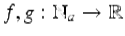 be given. Define the convolution product of f and g to be
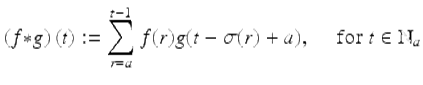
(2.42)
(note that  by our convention on sums).
Example 2.60.
For p ≠ 0, −1, find the convolution product e p (t, a) ∗ 1, and use your answer to find 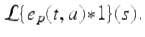 By the definition of the convolution product
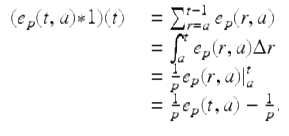
It follows that

Note from Example 2.60 we get that

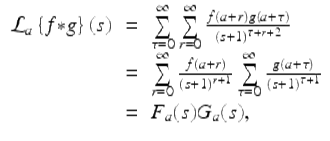
which is a special case of the following theorem which gives a formula for the Laplace transform of the convolution product of two functions. Later we will show that this formula is useful in solving fractional initial value problems. In this theorem we use the notation 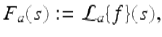 which was introduced earlier.
Theorem 2.61 (Convolution Theorem).
Let be of exponential order r 0 > 0. Then

(2.43)
Proof.
We have
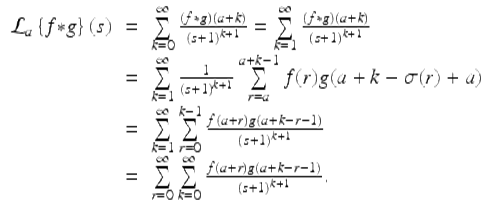
Making the change of variables 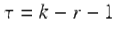 gives us that
for | s + 1 | > r 0. □
Example 2.62.
Solve the (Volterra) summation equation
![$$\displaystyle{ y(t) = 3 + 12\sum _{r=0}^{t-1}\;\left [2^{t-r-1} - 1\right ]\;y(r),\quad t \in \mathbb{N}_{ 0} }$$](fractional.files/image1366.png)
(2.44)
using Laplace transforms. We can write equation (2.44) in the equivalent form
![$$\displaystyle\begin{array}{rcl} y(t)& =& 3 + 12\;\sum _{r=0}^{t-1}[e_{ 1}(t - r - 1,0) - 1]y(r) \\ & =& 3 + 12\;[(e_{1}(t,0) - 1) {\ast} y(t)],\quad t \in \mathbb{N}_{0}.{}\end{array}$$](fractional.files/image1367.png)
(2.45)
Taking the Laplace transform (based at 0) of both sides of (2.45), we obtain
![$$\displaystyle\begin{array}{rcl} Y _{0}(s)& =& \frac{3} {s} + 12\;\left [ \frac{1} {s - 1} -\frac{1} {s}\right ]\;Y _{0}(s) {}\\ & =& \frac{3} {s} + \frac{12} {s(s - 1)}Y _{0}(s). {}\\ \end{array}$$](fractional.files/image1368.png)
Solving for Y 0(s), we get
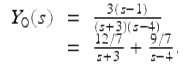
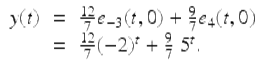
Taking the inverse Laplace transform of both sides, we get