Discrete Fractional Calculus (2015)
3. Nabla Fractional Calculus
3.11. Fractional Taylor Monomials
To find the formula for the Laplace transform of a fractional nabla Taylor monomial we will use the following lemma which appears in Hein et al [119].
Lemma 3.73.
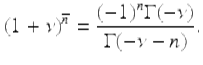
For  and n ≥ 0, we have that
(3.37)
Proof.
The proof of (3.37) is by induction for  . For n = 0 (3.37) clearly holds. Assume (3.37) is true for some fixed n ≥ 0. Then,
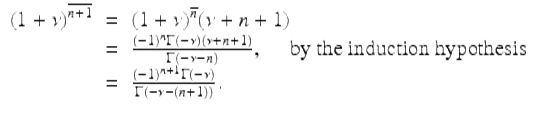
The result follows. □
We now determine the Laplace transform of the fractional nabla Taylor monomial.
Theorem 3.74.
For ν not an integer, we have that

Proof.
Consider for | s − 1 | < 1, | s | p > 1
![$$\displaystyle\begin{array}{rcl} & & \mathcal{L}_{a}\{H_{\nu }(\cdot,a)\}(s) =\sum _{ k=1}^{\infty }(1 - s)^{k-1}H_{\nu }(a + k,a) =\sum _{ k=1}^{\infty }(1 - s)^{k-1} \frac{k^{\overline{\nu }}} {\Gamma (\nu +1)} {}\\ & & \quad \quad =\sum _{ k=1}^{\infty }(1 - s)^{k-1} \frac{\Gamma (k+\nu )} {\Gamma (k)\Gamma (\nu +1)} =\sum _{ k=0}^{\infty }(1 - s)^{k} \frac{\Gamma (k + 1+\nu )} {\Gamma (k + 1)\Gamma (\nu +1)} {}\\ & & \quad \quad =\sum _{ k=0}^{\infty }(1 - s)^{k} \frac{(1+\nu )^{\overline{k}}} {\Gamma (k + 1)} {}\\ & & \quad \quad =\sum _{ k=0}^{\infty }(-1)^{k}(1 - s)^{k} \frac{\Gamma (-\nu )} {\Gamma (k + 1)\Gamma (-\nu - k)}\quad \quad \quad \text{(by Lemma <InternalRef RefID="FPar73">3.73</InternalRef>)} {}\\ & & \quad \quad =\sum _{ k=0}^{\infty }(-1)^{k}(1 - s)^{k}\frac{[-(\nu +1)]^{\underline{k}}} {\Gamma (k + 1)} {}\\ & & \quad \quad =\sum _{ k=0}^{\infty }(-1)^{k}{-(\nu +1)\choose k}(1 - s)^{k} {}\\ & & \quad \quad = \left [1 - (1 - s)\right ]^{-(\nu +1)}\quad \quad \text{(by the Generalized Binomial Theorem)} {}\\ & & \quad \quad = \frac{1} {s^{\nu +1}}. {}\\ \end{array}$$](fractional.files/image2009.png)
This completes the proof. □
Combining Theorems 3.67 and 3.74, we get the following corollary:
Corollary 3.75.
For  , we have that

Theorem 3.76.
The following hold:
(i)

(ii)

(iii)

(iv)

(v)

where (i) holds for 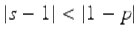 , (ii) and (iii) hold for
  and (iv) and (v) hold for
  .
.
Proof.
To see that (i) holds, note that
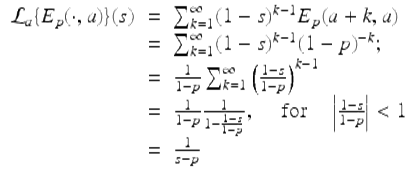
for 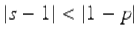 . To see that (ii) holds, note that for
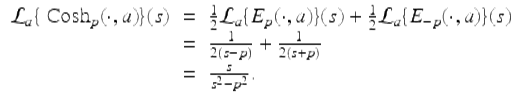
To see that (iv) holds, note that
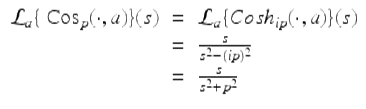
for  . The proofs of parts (iii) and (v) are left as an exercise (Exercise 3.31). □