University Mathematics Handbook (2015)
III. Analytic Geometry and Vectors
Chapter 4. Coordinate Systems in Space, Space Vectors
4.1 Vector Concept
a. A vector is a defined quantity with both direction and magnitude.
b. It is graphically represented by a directional segment, that is, a segment with an arrow on one end, representing the direction of the vector.
c. The absolute value of a vector is called the length or a vector.
d. Vectors are denoted by small, bold Latin characters  , and modules are denoted as
  . A vector starting at point
  and ending at point
  is denoted as
  and its length is denoted as
  or
or  .
.
e.  is the opposite vector of
  so they are denoted as
  .
.
f. A vector of length  is called unit vector.
g. Two vectors are equal if their lengths are equal and their directions are identical.
h. The angle between vectors is the angle between their positive-direction parts. So, if vectors  and
and  are parallel to each other, that is, they are situated on parallel lines, and have the same direction, the angle between them is zero. If vectors
  and are parallel to each other and are of opposite directions, the angle between them is
 .
.
4.2 Vector Algebra
a. Vector additions: vector  , the sum of vectors and , is denoted
  , and defined the following way: displace vectors and to common initial point . Vector
  is the diagonal of parallelogram constructed in vectors and from to .
Vector can also be constructed this way: Draw ; from the end of , draw . Connecting the initial point of to the end of , we obtain vector  .
.
b. Adding more than two vectors is defined similarly.
c. If  is the angle between vectors and , then:
 .
.
d. Vector subtraction: The difference of vectors and is vector  , for which holds
  .
.
e. The projection of vector on  is scalar
  which equals to the length of directed segment
  , when
  is the projection of the initial point and
  , the projection of the terminal point of , marked with plus when
  is at the direction of
  , and with minus when it is in the opposite direction of .
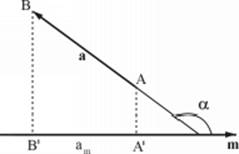
f. The projection of the sum of two vectors equals to the sum of their projections.
g. The projection of a difference of two vectors equals to the difference of their projections.
4.3 Vector Triangle Inequality
For all two vectors a and b there holds

4.4 Cartesian Coordinate System in Space
a. Unit vectors  define a right-handed Cartesian system, if:
1. They are perpendicular to each other

2. All three vectors are initiated in one point, and, the motion from  to
to  counterclockwise is visible from the terminal point of vector
  .
.
b. Cartesian coordinate system in space consists of three axes originating from one point  :
:  -axis at the direction of vector ;
  -axis at the direction of vector , and
  -axis at the direction of vector .
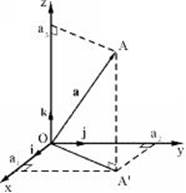
c. Every vector can be represented in the form of 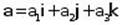 . Three entities
  are called Cartesian coordinates.
d. The space coordinates of point  are the space coordinates of vector
  .
.
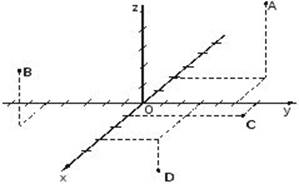
e. For every point in space there is a corresponding ordered set of three real numbers, and for every ordered set of three real numbers, there is a corresponding point in space.
f. Example: In the following Figure, there are points

4.5 Vector in Coordinate System
Let's give vectors 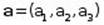 ,
,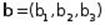 , and scalar , then:
a. 
b. 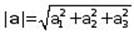
c. 
d. 
e. is parallel to  if, and only if,
4.6 Vector Direction in Space
a. Direction angles of vector , are angles  it forms with the positive direction of axes
  , respectively.
b. Direction cosines of are 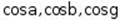 .
.
c. If , then
 .
.
d. 
4.7 Inner (Scalar) Product
a. The inner product of two vectors , is scalar  ( dot ), defined as:

when is the angle between the vectors.
b.  , when
  is the projection of on , and
  is the projection of on .
c. Vectors and are mutually perpendicular if, and only if,  .
.
d. If 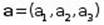 and , then:
 .
.
e.  , ( is a scalar).
f.  .
.
g. 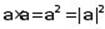 .
.
4.8 Cross (Vector) Product
a. Cross product of vectors , is vector denoted as  ( cross ), which holds:
1.  , when is the angle between vectors , . In other words, the length of vector
  equals the area of the parallelogram with vectors for sides.
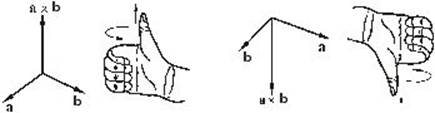
2. Vector is perpendicular to the plane of vectors and , and its direction is such that, from the terminal point of the motion from to counterclockwise is visible (right-hand rule).
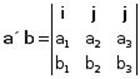
b. If and 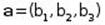 , then

c. Vectors and are collinear if, and only if,  .
.
d.  .
.
e.  .
.
f.  .
.
4.9 Vector Triple Product
a. The multiplication of  , of vectors
 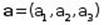 ,
, 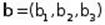 ,
, 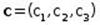 is called triple product.
b. 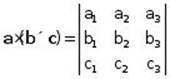
c. 
d. is a scalar modulus of which equals to the volume of parallelepiped constructed on vectors  .
.
e. Vectors are coplanar, or situated on the same plane, if, and only if,  .
.