University Mathematics Handbook (2015)
III. Analytic Geometry and Vectors
Chapter 9. Cylindrical and Spherical Coordinates
9.1 Cylindrical Coordinates
a. A cylindrical coordinate system combines the polar coordinates in a plane (see II 1.2), with vertical coordinate  in a space. The cylindrical coordinates of point
  in space are ordered set of three numbers
  , when
  are the polar coordinates of projection
  of point on plane
  (see illustration). Remember that
  is distance, and therefore can be either positive or zero, and angle
  varies from zero to
  .
.
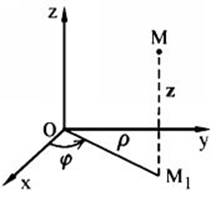
Formulas of conversion from cylindrical coordinates  to Cartesian coordinates
  are
are

To reverse the conversion, from to

b. In cylindrical coordinates, the cylindrical surface equation has a simpler form.
Example: The equation of cylinder  is
is
 ,
,  ,
, 
That is, it is the equation of the locus for all sets of points at distance  from
from  -axis.
9.2 Spherical Coordinates
a. Point  in space is defined by the set of three numbers
  , when
  is the length of vector
  (when
(when  is the origin),
  is the angle of projection
  with the positive direction of
  -axis on plane
  , and
, and  is the angle formed by vector with the positive direction of -axis.
 are called the spherical coordinates of
point .
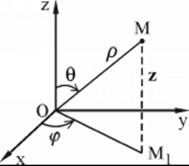
b. Relation between spherical and Cartesian coordinates:
1. If is a point of spherical coordinates , then
 .
.
2. If  are Cartesian coordinates of point , then

when only has positive values, values vary from zero to  and angle varies from zero to
  .
.
c. Examples:
1. The spherical coordinates of point (2,1,2) are:

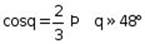
2. The equation of sphere 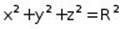 in spherical coordinates is

d. Note: Sometimes angle is referred to as the angle between vector and plane  . In the illustration above, it is
  .
.
In such a case, is substituted with  , so the equation of sphere
 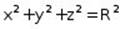 in spherical coordinates is
 .
.