University Mathematics Handbook (2015)
I. Basic Concepts
· Integers set: 
· Natural numbers set: The positive integers 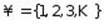
· Rational numbers set: 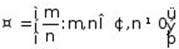
· Real numbers set: 
· Irrational numbers set:  (all real numbers that are not rational)
· Complex numbers set: 
· Infinity: 
· An open interval: 
· A closed interval: 
· A half-closed interval:  or
or 
· A ray:  ,
,  ,
, 

· The  neighborhood of
  is the interval
 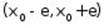 :
: 
·  : Proposition
  leads to proposition
  , or proposition is derived from proposition . For example: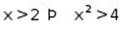
·  : Propositions and are equivalent. For example: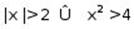
·  : “For all.” For example:
  “for all natural
  “
“
·  : “There exists.” For example:
 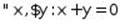 “for all
  , there exists
  , such that
  “
“
·  : “Is a member of.” For example: If
  is a member of set , then
·  2.71828….
·  3.14159…..
· ( factorial)  ,
, 
· Stirling's formula: 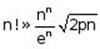 as
as 
· 
· 
0.1 Areas
a. The area of a triangle:
1.  , where
  is the altitude of side .
2. Heron's formula:  where
where  are the triangle sides and
 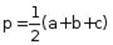 is half of the perimeter.
3.  , where
  is half of the perimeter and
  is the radius of the circle in the triangle.
4. 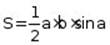 , where
  is the angle between sides
and  .
.
b. The area of a parallelogram is the product of the side's length and the height of that side.
c. The area of a rhombus is half the product of the lengths of its diagonals.
d. The area of a rectangle is the product of its height and its width.
e. The area of the trapezoid is equal to half the product of the length of an altitude and the sum of the lengths of the bases.
f. The area of a circle is  , where is the radius of the circle.
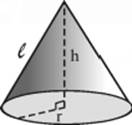
g. The lateral surface area of a right circular cone is  , where is the radius of the circle and
  is the lateral altitude of the cone (see next Figure).
h. The lateral surface area of a ball with an  radius is
  .
.
0.2 Volumes
a. The volume of a cuboid with  dimensions is
  .
.
b. The volume of a parallelepiped is the product of the area of its base ( ) and the altitude of its base (
 ):
):  .
.
c. The volume of a pyramid is a third of the area of the base multiplied by the altitude of the base:  .
.
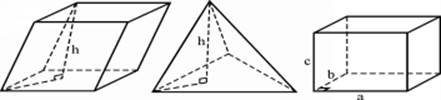
d. The volume of a right circular cylinder is  , where is the radius of the circle and is the altitude of the cylinder.
e. The volume of a right, circular cone is  , where is the radius of the base and is the altitude of the cone.
f. The volume of a ball is  , where is the radius of the ball.
0.3 Greek Alphabet
|
|
alpha |
|
nu |
|
|
beta |
|
xi |
|
|
gamma |
|
omicron |
|
|
delta |
|
pi |
|
|
epsilon |
|
rho |
|
|
zeta |
|
sigma |
|
|
eta |
|
tau |
|
|
theta |
|
upsilon |
|
|
iota |
|
phi |
|
|
kappa |
|
chi |
|
|
lambda |
|
psi |
|
|
mu |
|
omega |


