University Mathematics Handbook (2015)
II. Functions
Chapter 1. General Properties of Functions
1.1 Definition
Let  and
and  be two sets of real numbers.
A function is a given rule fitting each number  in set , a one and only one number
  of set .
That function is denoted as  , which says
  of , or
  , which reads is into .
Set is called the function's domain.
 is called an input variable or argument.
If , then is said to be the image of , or is the preimage of .
If  is described by an algebraic expression, then the maximum set of real numbers for which the expression exits is the natural domain of
  .
.
is bounded on domain if there exists a number  such that
  for all
  .
.
Example: The domain of  is
is  ,
,  .
.
The graph of function is a set of all pairs of coordinates  where belongs to .
1.2 Increasing and Decreasing Functions
The function is increasing in domain if for every two points  and
and  from , and where
  there holds
  .
.
The function is decreasing in domain if for every two points and , which are members of , and where there holds  .
.
If the inequality is strict, then the function is strictly increasing (or decreasing).
Example: The function  is increasing in the domain
  and decreasing in
  , and is neither increasing nor decreasing in any interval containing the point
  .
.
The graph of an increasing function in an interval is a curve ascending from left to right.
The graph of a decreasing function in an interval is a curve descending from left to right.
1.3 Odd and Even Functions
is called an even function if for all in its domain there is also  in its domain, such that
  .
.
Example: ,  , and
, and  are even functions.
 is called an odd function, if for all in its domain there is also in its domain, such that
 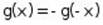 .
.
Example:  ,
,  , and
, and  are odd functions.
Example:  is neither an even nor an odd function.
The sum of two even (or odd) functions is an even (or odd) function.
The product of two even (or odd) functions is an even function.
The product of an even function and an odd function is an odd function.
A graph of an even function is symmetric about the axis.
A graph of an odd function is symmetric about the origin.
1.4 Periodic Function
 is called a periodic function if there exists a positive number
  such that for all
  there is also
  and there holds
 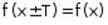 .
.
The minimum , if it exists, is called the period of .
Example: , and are periodic functions with a  period.
1.5 One-to-One Correspondence Function (Bijective Function)
 is a one-to-one correspondence function
  if for all of there exists at most one of such that .
In other words,  is a one-to-one correspondence function if for all
  of if
of if  then
then  .
.
Example: is a bijective function in the domain 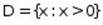 and not bijective in
  , since for
  ,
,  there holds
 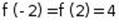 .
.
1.6 Surjective Function
The function is a surjective function if for all  there exists a such that .
Examples:
a.  is a surjective but not one-to-one correspondence function.
b.  is both a surjective and a one-to-one correspondence function.
1.7 Inverse Function
Let . If for every of there exists a unique of such that  , then is called an invertible function, and
 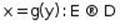 is the inverse function of . That is,
  and
and  .
.
Examples:
a. The inverse function of  is
is 
b. The inverse function of ,  is
is 
In the inverse function  the input variable is and the output variable is . It's more convenient to have here as the input variable, so and are switched, and the result is the inverse function
  .
.
In the previous example, the inverse function of was  .
.
Theorem: If is invertible and is its inverse function, then the graphs of these two functions are symmetric to each other about the line 
(Figure 8).
Theorem: The function is invertible if, and only if, it is a one-to-one correspondence and a surjective function.
1.8 Equivalent Sets
a. Set  is called equivalent to set
  if there exists a one-to-one correspondence and surjective function
  .
.
Example: Interval  is equivalent to as one-to-one correspondence function
  mapping on .
b. A set equivalent to natural numbers set  is called a countable set.
Example: Sets  and
and  are countable sets.
c. A set equivalent to interval  is called a linear continuum.
Example: Open or closed intervals, , and  are continuum.
1.9 Operations with Functions
Let  ,
,  .
.
Functions  ,
,  and
and  are only defined when belongs to
  as well as to
  , and therefore, are defined in domain
  .
.
To compose and  , when
  , is function
  , which results from
  .
.
Order of operations is significant. First, is applied to and, only then,  is applied to .
Example:  ,
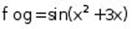
, 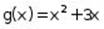 , therefore
 ,
, 
1.10 Elementary Functions
The functions, resulting from the functions  (constant),
  ,
,  ,
,  by their addition, subtraction, multiplication, and partition, their compositions and their inverses, are elementary functions.
Examples:
a. Function  is elementary since
  .
.
b. 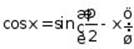 and therefore, is an elementary function.