University Mathematics Handbook (2015)
VI. Series
Chapter 1. Basic Concepts
1.1 Series of Numbers. Summation of Series
a. Let  be a sequence of numbers.
The expression 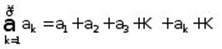 is called infinite series or just a series, and ak is the general term of the series.
The terms of the series add up to partial sums:
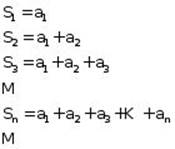
The result is a sequence of partial sums  .
.
b. Series  is convergent if there exists a finite limit
  of the sequence of partial sums
  . is called the sum of the series. Written
  .
.
If the limit of does not exist, or is infinity, the series is called divergent.
c. Examples:
1. Geometric Series 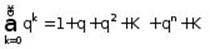
converges if and only if  and its sum is
  .
.
2. Leibniz Series 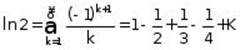
3. Series 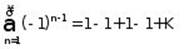 is divergent.
4. Harmonic Series 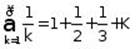 .
.
1.2 Series Remainder
The series 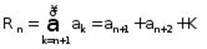 is the
  -th remainder of the series
  ,
,  .
.
1.3 Telescoping Series
a. Let  be a sequence of numbers. Series
  is called telescoping series.
b. A telescoping series is convergent if and only if sequence  is convergent.
c. If sequence converges to  , then the sum of the telescoping series is
  .
.
1.4 Properties of Convergent Series
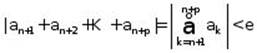
a. Cauchy's Criterion: Series converges if and only if
 ,
,  ,
,  ,
, 
b. Necessary Condition of Convergence
If series converges, then  .
.
This is an insufficient condition: For instance, for harmonic series  , there holds
  , yet the series is divergent.
c. If series  is convergent, then the sequence of remainders
  converges to zero. That is, for every
  there exists
  such that for all
  , there holds
  .
.
1.5 Operation on Series
a. Removing a finite number of terms from a series, or adding a finite number of terms to it, does not affect the convergence or divergence of the series.
Attention: It does change the sum of the series.
b. If converges to , then, for every constant  the series
  converges to
  .
.
If series is divergent, then, for all  , the series , is divergent.
c. If series  ,
,  are convergent, then, the series
  is convergent, and
 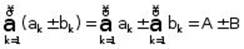 .
.