University Mathematics Handbook (2015)
VII. Differential Calculus of Multivariable Functions
Chapter 11. Extrema of Multivariable Functions
11.1 Critical Points
a. Function  has a local maximum (or minimum) on
  , if there exists a neighborhood of such that for all
  of that neighborhood there holds

b.  which is a local maximum or minimum point is called a point of local extremum of
  .
.
c. Necessary Condition for the Existence of Extremum: if function has an extremum on , and, in addition, it has first-order partial derivatives at that point, then all these derivatives equal zero on .
d. is a critical point of  if all partial derivatives of equal zero at .
e. All critical points and points at which at least one partial derivative does not exist are suspected extrema points.
11.2 Types of Critical Points
If 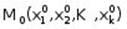 is a critical point of function
  belonging to class
  (it has continuous partial derivatives up to second order), and the quadratic form (see next paragraph).

of variables 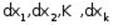 is
is
1. Positive, then function  has local minimum on .
2. Negative, then function has local maximum on .
3. Mixed, then function has no extremum on .
11.3 Analysis of Quadratic Forms
The matrix of quadratic form  (see XI.12) is
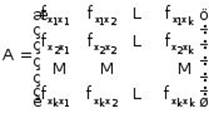
and

are k first minors of matrix A.
Sylvester Theorem: The form is positive if, and only if, all first minors of matrix  are positive. Quadratic form is negative if, and only if, the sign of its first minors change alternately, the first sign being negative.
11.4 Extremum of a Two-Variable Function
Function  has a local extremum on
  in which
  ,
,  , and
, and  . If
. If  , then it is the local minimum, and if
  , then it is the local maximum. If
  , function
  has no extremum on . In such a case, is a saddle point.