University Mathematics Handbook (2015)
VII. Differential Calculus of Multivariable Functions
Chapter 12. Extrema with Constraints
Let  be a function with two constraints:
 (*)
(*)
a. Definition: Function  has a maximum (or minimum) under the conditions of (*) on
 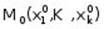 if
if  ,
,  and there exists a neighborhood of
  such that for all point
  of that neighborhood which is under the constraints, that is,
  , there holds:
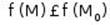 ,
, 
b. Lagrange Multiplier Method of finding critical points with (*) constraints:
Construct a Lagrange function 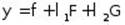
where  are Lagrange multipliers.
c. A Necessary Condition for the Existence of Extremum: To find critical points, one must solve a system of  equations where

With unknowns which are 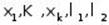 to its solutions are include all the points where its derivatives do not exist.
d. Absolute Extremum of a Function Continuous Above Bounded and Closed Domain  : According to Weierstrass theorem, a continuous function has its maximum and minimum value on .
The function may reach these values of critical points within domain or on the boundary of , or on singular points on the boundary of .
Therefore, to find the maximum and minimum values of the function on a bounded and closed domain, one must find all critical points, (both interior and boundary points, including singular boundary points), and, by comparing the values of the function on these points, absolute maxima and minima in domain can be found.