University Mathematics Handbook (2015)
X. Algebra
Chapter 9. Linear Transformations
9.1 Transformations
a. Let  and
and  be two nonempty sets. If, for each
  , there is a unique corresponding element
  , it is called transformation from to and is denoted
  or
or  .
.
 is the preimage of
  , and is the image of .
The image of transformations is the set of all images of . It is denoted  .
.
b. is one-to-one correspondence transformation (denoted  ) if different elements of have different corresponding images, that is,
  or
or  .
.
c. is onto if  . In other words, every
  has at least one preimage of .
d. Let  be a transformation from to , and let
  be subset of . Transformation
  is a restruction of on , if its domain of definition is , in which it is defined exactly like , that is, for every
  ,
,  .
.
9.2 Isomorphism
a. Definition: Let  and
and  be two vector spaces over field
  . One-to-one correspondence transformation
  of vector space over vector space is called isomorphism if for every
  and
and  , there holds:

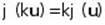 .
.
b. Spaces and are isomorphic if the exists isomorphism from to .
c. If spaces and are isomorphic, then, under this isomorphism, a zero of space is transformed to a zero of space .
d. If is an isomorphism from vector space to , then set of vectors 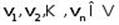 is linearly dependent if, and only if, the set of images
  is linearly dependent on
  .
.
e. If spaces and are isomorphic, then a linearly independent set on transforms under the isomorphism to linearly independent set in . Therefore, one basis transforms to another basis and 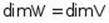 .
.
f. If is an  -dimensional vector space over field , then space is isomorphic to
  .
.
g. Every two -dimensional vector spaces over the same field are isomorphic.
9.3 Linear Transformation
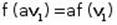
a. The transformation from into  is called a linear transformation, if for every
  and
and  there holds:
1. 
2. 
b.  . That is, in a linear transformation, the image of zero
  of is (zero)
  of .
of .
c. An identity transformation  , which transforms every vector in to itself, is a linear transformation from on .
d. A zero transformation  , which transforms every vector of to zero vector of , is a linear transformation from to .
e. If  is a basis of and
  are vectors (not necessarily linearly independent) in space , then there exists a unique linear transformation
  from to , such that
  ,
,  .
.
9.4 Image and Kernel of Linear Transformation
a. If 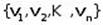 is a basis in vector space and is a linear transformation from to , then the image of transformation is:

b. The Kernel,  , of linear transformation
  is the set of vectors in the images of which are the zero vector of ,

c. If is a linear transformation, then:
1.  is a subspace of .
2. is a subspace of .
d. If is a linear transformation and is an -dimensional vector space, then

e.  is the transformation rank of
  .
.
9.5 Linear Operator
a. A linear operator on is a linear transformation from to itself.
b. Linear operator  is non-singular if
  . Otherwise, is a singular operator.
c. Linear operator is one-to-one correspondence if, and only if, is non-singular.
d. If and are linear operators on , then operators  and
and  , defined as
  and
and 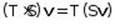 ,respectively, are linear operators on .
e. Linear operator is called invertible if there exists operator  such that
 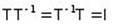 .
.
f. If and are invertible operators, then operator  is invertible, and
 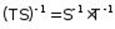 .
.
g. If is a linear operator in an -dimensional vector space, the following propositions are equivalent:
1. is one-to-one correspondent.
2. is non-singular.
3. is onto.
4. is invertible.
9.6 Matrix Representation of Linear Operator
a. Let and let  be a basis in . We represent
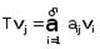 ,
, 
The -th order square matrix
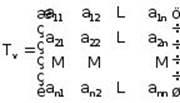
is the representative matrix of operator with respect to basis , or that  is a matrix representation of on .
b. If is a linear operator and  is a basis of , then, for every vector
  , there holds
  .
.
c. Let  and be bases in vector space . If
  is a matrix of transformation from to , then, for every linear operator , there holds

when  are matrix representations of , with respect to bases and .