University Mathematics Handbook (2015)
XII. Complex Functions
Chapter 4. Complex Function Derivative
4.1 Definition
a. If the single-valued function  has a finite limit
 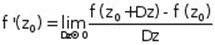 , then
  is said to be differentiable on
  .
.
b. If function is differentiable on , it is continuous on that point.
4.2 Derivative Rules
If  is constant, and functions and
  are differentiable, then:
a. 
b. 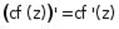
c. 
d. 
e. 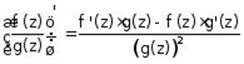 ,
, 
f. A composite function derivative: If is differentiable on , and  is differentiable on
  , then composite function
 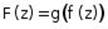 is differentiable on
  and
and  .
.
g. 
h. 
i. 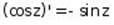
j. 
4.3 Cauchy-Riemann (CR) Criterion (Equations)
a. Function  is differentiable at point
  if and only if
  and
and  are differentiable at
  , and
, and

In this case: 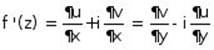
b. CR criterion in polar coordinates: if

then, is differentiable if, and only if,
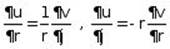 and its derivative is

4.4 Analytic Function
a. Single-valued function is analytic function on if there exists neighborhood  , such that is differentiable on every point of it.
b. If a function is analytic at a point, then it is continuous on it.
c. Analytic function is sometimes called a holomorphic function or regular function.
d. An analytic function at every point of complex plane  is called an entire function.
e. A single-valued function is analytic on domain  if it is differentiable at every point of the domain.
f. A set of points where is analytic has to be an open set. If is said to be analytic in closed set  , it means there exists open set
  containing
  , where is analytic.
g. If functions and are analytic on , then functions  ,
,  and
and  when does not zero at any point of , are also analytic on .
h. The composition of analytic functions is an analytic function.
i. A single-valued branch of a multivalued function is an analytic function in domain if it is differentiable at any point of .
4.5 Harmonic Functions
a. A two-variable real function  is harmonic in domain if it is continuous and has continuous partial derivatives up to second order and satisfy the Laplace equations (see XIV.7).

b. If function is analytic in domain , then functions and are harmonic
on .
c. If and are harmonic on and hold the C.R. criteria on , then function is called a harmonic conjugate function to  on .
on .
d. Function is analytic on if and only if  is a harmonic conjugate to on .
e. For every function harmonic on , there exists harmonic function conjugate to .
4.6 Conformal Mapping
a. The transforming of one complex plane on another one is called conformal mapping or transformation at if it preserves the magnitude and direction of the angles and expands constantly in all directions. In other words, a transformation is conformal if it transforms a small enough triangle the vertex of which is on to a small enough triangle similar to it.
b.  is conformal mapping in domain if, and only if, function is analytic on and
  ,
,  .
.
c. Riemann's theorem: There exists analytic function mapping simply connected domain on simply connected domain  except in two cases:
and/or are full complex plane;
and/or are all full complex plane pierced in one point.
d. If function is analytic in simply connected domain and continuous on , objectively mapping the boundary  of on curve
  in plane
  and preserves the direction of , then conformly maps domain to a domain bounded by curve .
e. Examples:
1. Displacement: 
2. Rotation:  (
( real constant). In this case
  and
and  , that is, point
  transforms to point
  by a rotation of vector around the origin at angle .
3. Extension: 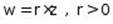 . In this case,
  and
and  . Therefore, point transforms to point on line
  at a
at a  times the distance
  . This mapping is expansion when
  , or contraction, when
  .
.
4.7 Möbius Transformation
a. The transformation 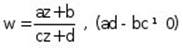
when  are constant complex numbers is called Möbius transformation or bilinear transformation.
b. Circles and straight lines in the complex plane are called generalized circles.
c. Möbius transformation maps generalized circles in plane to generalized circles in plane .
d. If  and
and  are points symmetrical about circle
  in plane , that is, they are on the ray originating from center
  of circle , and the product of distances
  equals to the square of the radius of the circle,
  , then, after a Mobius mapping, their images
  and
and  will be symmetrical with respect to circle
 , the image of circle .
e. There exists a unique Mobius transformation mapping three different points  , in plane to three different points
  in plane . This transformation is:

If one of the points equals  , then all the differences including that point are replaced with
  .
.