University Mathematics Handbook (2015)
XII. Complex Functions
Chapter 5. Integrals of Complex Functions
5.1 Line Integral in the Complex Plane
Let  be a continuous function in domain
  . Suppose
  is a continuous curve entirely in , starting at
  and ending at
  . Let us define integral over directed from
  to :
to :

when the right side integrals are real line integrals (see IX, 9.1).
5.2 Properties of the Integral
a.  , when is directed from to .
b. 
c. 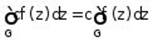 ,
,  is a complex constant.
d. 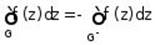 , when
  is a curve in the opposite direction of , that is, from to .
e. If curve consists of several curves  , then

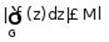
f. If, along the line of , function  is bounded, that is
  (
( constant) and
  is the length of (see formula in IX.5), then
5.3 CauchyTheorem and its Applications
a. If function is analytic in a simply-connected (multi-connected) closed and bounded domain  with boundary , then

b. If function is analytic in multi-connected closed domain , then the integral along the interior boundary paths equals the sum of integrals by the inner boundary paths of domain , when all boundary paths are directed counterclockwise.
c. Let be analytic function in a simply-connected domain . Let  and
and  be points belonging to domain . Then, the integral
  is independent of the path connecting and , directed from to , which is entirely in .
d. If function is analytic in simply-connected domain , then function 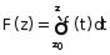 , is also analytic in , and
  .
.  is called the anti-derivative of .
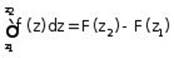
e. Newton-Leibniz formula: If is the anti derivative of  , then
5.4 Cauchy Integral Formula and its Applications
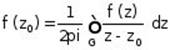
a. If function is analytic in simply-connected domain and is a continuous closed curve contained in , then, for every inner point z0 of there holds
b. If function is analytic in closed domain with boundary , then it is infinitely differentiable at every point in and its  -th derivative equals to

c. Morera's theorem: If function is continuous on and  for every closed path in , then is analytic in .
d. Maximum (absolute value) module principle: If non-constant function is analytic in bounded domain and continuous in , then the module of  attains its maximum value on the boundary of .
e. Liouville’s theorem: If function is analytic over the whole (entire) plane and bounded over it, that is, there exists a positive number such that for every there holds  , then is a constant function, that is,
  for every .
f. Fundamental theorem of algebra: Every equation in the form of

with complex coefficients has at last one root, that is, there is a least one complex such that  .
.