University Mathematics Handbook (2015)
XIV. Partial Differential Equations (PDE)
Chapter 6. Method of Separation of Variables
6.1 Solution of the Wave Equation
 (*)
(*)
with one of the following boundary value problems:
a. Dirichlet problem 
b. Neumann problem 
c. Mixed problem 
d. Mixed problem  ;
;
and initial condition: 
We look for a non-trivial solution of (*) in the form of  holding one of the four boundary conditions. As a result of substitution in (*) and separation of variables by division by
  , we get
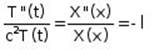
From that equation, follows the equations system
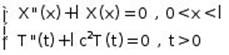
For the solution  to hold a boundary condition, for example, a Dirichlet condition, there must hold
  .
.
To find  , we get Sturm-Liouville problem (see XI.5).
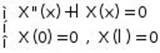
With eigenvalues 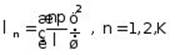 and eigenfunctions
 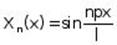 .
.
For every eigenvalue  we get the equation
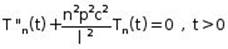
Its solutions are 
Therefore, we obtain particular solutions


Following the generalized superposition principle, function

is the generalized solution of the wave problem (see XIV.5.2) when coefficients  and
and  are deduced from the initial condition
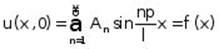 ,
, 
That is, are Fourier coefficients of  and
and  are Fourier coefficients of the expansion of
  to a Fourier series by cosines (see XIII, 1.5. 1.6).
6.2 Solution of Homogeneous Heat Equation

Boundary condition:
Initial condition: 
Compatibility condition: 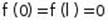
We look for a solution in the form of . Substituting, we get the Sturm-Liouville problem

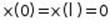
with eigenvalues 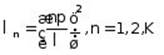 and eigenfunctions
 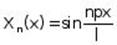 .
.
Function 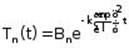 is a solution of the equation
 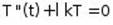 . Therefore, the solution of the heat equation is
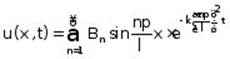
From the initial condition, we get
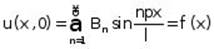
Therefore, 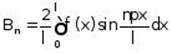 are Fourier coefficients of function .
6.3 General Heat Equation and the Maximum Principle
a. The Maximum Principle:
If  is a continuous solution in rectangle
  ,
,  of heat equation
  , then attains its maximum on the base
  or sides
  and
and  .
.
b. Heat problem
 ,
,  ,
, 


has a continuous solution on  , and its is unique.
c. Heat problem


has a unique bounded and continuous solution.
If  , the solution is
