Discrete Fractional Calculus (2015)
1. Basic Difference Calculus
1.10. Stability of Linear Systems
At the outset of this section we will be concerned with the stability of the trivial solution of the vector difference equation

(1.48)
where A is an n × n constant matrix. By the trivial solution of (1.48) we mean the solution y(t) ≡ 0,  (here by context we know 0 denotes the zero vector). First we define what we mean by the stability of the trivial solution on
  We will adopt the notation that y(t, z) denotes the unique solution of the IVP

Definition 1.94.
Let  be a norm on
  . We say the trivial solution of (1.48) is stable on
  provided given any ε > 0, there is a δ > 0 such that
  on if
on if  If this is not the case we say the trivial solution of (1.48) is unstableon . If the trivial solution is stable on
  and
and  for every solution y of (1.48), then we say the trivial solution of (1.48) is globally asymptotically stable on .
We will use the following remark in the proof of the next theorem.
Remark 1.95.
An important result [137, Theorem 2.54] in analysis gives that for any n × n constant matrix M, there is a constant D > 0, depending on M and the norm on , so that

for all  .
.
Theorem 1.96.
If the eigenvalues of A satisfy  , 1 ≤ k ≤ n, then the trivial solution of (1.48) is globally asymptotically stable on .
Proof.
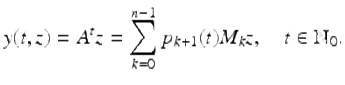
We will just prove this theorem for the case a = 0. Let  and fix δ so that 0 ≤ r < δ < 1. From the Putzer algorithm (Theorem 1.88), the solution y(t, z) of (1.48) satisfying y(0, z) = z is given by
(1.49)
We now show that for each 1 ≤ k ≤ n there is a constant B k > 0 such that

(1.50)
By (1.44),

Iterating this inequality and using p 1(0) = 1, we have

Hence if we let B 1 = 1 and use the fact that r < δ we have that

Hence (1.50) holds for k = 1. We next show that there is a constant B 2 > 0 such that

From (1.44) we get
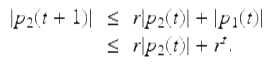
It follows from iteration and p 2(0) = 0 that
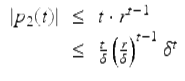
for  . L’Hôpital’s rule implies that
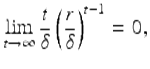
so there is a constant B 2 > 0 so that

Hence (1.50) holds for k = 2. Similarly, we can show that for
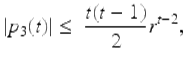
from which it follows that there is a B 3 so that

Continuing in this manner, we obtain constants B k > 0, 1 ≤ k ≤ n so that

for k = 1, 2, ⋯ , n. Using Remark 1.95 we have there are constants D k such that

for all  Using this and (1.49) we have that for ,
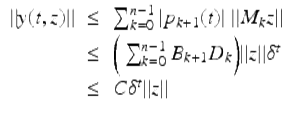
(1.51)
where 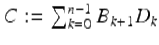 . It follows from (1.51) that the trivial solution is stable on
  . Since 0 < δ < 1, it also follows from (1.51) that
  . Hence the trivial solution of (1.48) is globally asymptotically stable on
  . □
. □
Example 1.97.
Consider the vector difference equation
![$$\displaystyle{ u(t+1) = \left [\begin{array}{ll} \;\;1 & - 5\\.25 & - 1 \end{array} \right ]u(t). }$$](fractional.files/image711.png)
(1.52)
The characteristic equation for ![$$A = \left [\begin{array}{ll} \;\;1 & - 5\\.25 & - 1 \end{array} \right ]$$](fractional.files/image712.png) is
is  and hence the eigenvalues of A are
  and
and  . Since
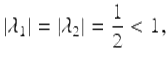
we have by Theorem 1.96 the trivial solution of (1.52) is globally asymptotically stable on .
In the next theorem we give conditions under which the trivial solution of (1.48) is unstable on .
Theorem 1.98.
If there is an eigenvalue,  , of A satisfying
  , then the trivial solution of (1.48) is unstable on .
Proof.
Assume  is an eigenvalue of A so that . Let v 0 be a corresponding eigenvector. Then
  is a solution of equation (1.48) on , and

This implies that the trivial solution of (1.48) is unstable on . □
Example 1.99.
Consider the vector difference equation
![$$\displaystyle{ y(t+1) = \left [\begin{array}{ll} -.5&\;\;\;3\\ \;\;\;.5 & - 1 \end{array} \right ]y(t). }$$](fractional.files/image722.png)
(1.53)
The characteristic equation for ![$$A = \left [\begin{array}{ll} -.5&\;\;\;3\\ \;\;\;.5 & - 1 \end{array} \right ]$$](fractional.files/image723.png) is
is 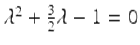 and so the eigenvalues are
 Since
Since  we have by Theorem 1.98 that the trivial solution of (1.53) is unstable on
In the next theorem we give conditions on the matrix A which implies the trivial solution is stable on .
Theorem 1.100.
Let 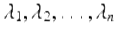 be the eigenvalues of A. Assume
  and whenever
  , then
  is a simple eigenvalue of A. Then the trivial solution of (1.48) is stable on .
Proof.
We prove this theorem for the case a = 0. If all the eigenvalues of A satisfy  , then by Theorem 1.96 we have that the trivial solution of (1.48) is stable on . Now assume there is at least one eigenvalue of A with modulus one. Without loss of generality we can order the eigenvalues of A so that
  for
for  , where 2 ≤ k ≤ n and for
 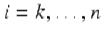 . From equations (1.44) and (1.45),

Next, p 2 satisfies

so (as in the annihilator method)

Since  ,
,

for some constants B 12, B 22. Continuing in this way, we have

for . Consequently, there is a constant D > 0 so that

for and .
From (1.44),  and hence

Choose  . Then

By iteration and the initial condition p k (0) = 0,
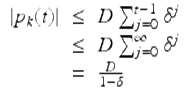
for . In a similar manner, we find that there is a constant D ∗ so that

for 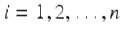 and .
and .
From Theorem 1.88, the solution of equation (1.48) satisfying u(0) = u 0, is given by
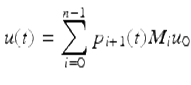
and it follows that

for and some C > 0. □
Example 1.101.
Consider the system
![$$\displaystyle{ u(t+1) = \left [\begin{array}{ll} \;\;\;\cos \theta &\sin \theta \\ -\sin \theta &\cos \theta \end{array} \right ]u(t),\quad t \in \mathbb{N}_{ a}, }$$](fractional.files/image752.png)
(1.54)
where  is a real number. For each
  the eigenvalues of the coefficient matrix in (1.54) are
  Since
Since 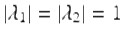 and both eigenvalues are simple, we have by Theorem 1.100 that the trivial solution of (1.54) is stable on . From linear algebra the coefficient matrix in (1.54) is called a rotation matrix. When a vector u is multiplied by this coefficient matrix, the resulting vector has the same length as u, but its direction is radians clockwise from u. Consequently, every solution u of the system has all of its values on a circle centered at the origin of radius | u(a) | . This also tells us that the trivial solution of (1.54) is stable on
  but not globally asymptotically stable on