University Mathematics Handbook (2015)
V. Integral Calculus of Single-Variable Functions
Chapter 1. Indefinite Integral
1.1 Antiderivative
a. The function  is the antiderivative of
  in domain
  , if, for all
  of , there holds
  .
.
b. If is an antiderivative of , then, for all constant  ,
,  is also an antiderivative of .
c. The set of all antiderivatives  of is called the indefinite integral of . It is denoted
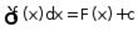
1.2 Properties of Integral
a. 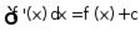
b. 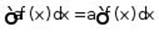
c. 
1.3 Immediate Integrals Table
|
a. |
b. |
|
c. |
d. |
|
e. |
f. |
|
g. |
h. |
|
i. |
j. |
|
k. |
l. |
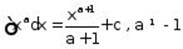
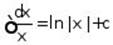
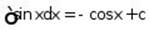
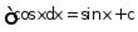
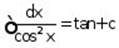
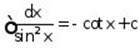
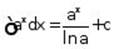
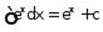
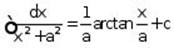
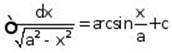
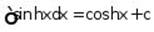
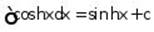
1.4 Integration by Parts

Example: To calculate  , let's write
  , and
, and  .
.
Therefore,  and
and 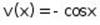 .
.
Substituting in the formula, we get


1.5 Substitution Method
a. This way, we substitute variable  in the function with a function of another variable,
  :
:  . This way, the integral in the right side is simpler.

Finding out the integral, we return to variable x. The equality is meaningful if function  is invertible.
Example: To calculate  , let's substitute
  . Therefore,
  , and the result is

b. For integrals in the form of  , the substitution is
  .
.
c. For integrals in the form of  , the substitution is
  .
.
d. For integrals in the form of 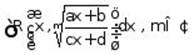 , when
  is a rational function of two-variables, the substitution is
  , from there follows
  . After substitution in the integral, we get a new integral containing no roots.
e. For integrals in the form of 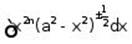 , the substitution is
  or
or  .
.
f. For integrals in the form of 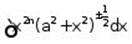 , the substitution is
  ,
, 
g. For integrals in the form of 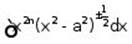 , the substitution is
  ,
,  .
.
1.6 Trigonometric Functions Integration
Calculating the integrals of trigonometric function involves using the relevant trigonometric identities.
a. Integrals

In each of these cases, we should use the relevant trigonometric identities (see II, 2.6 and Chapters 8-10), turning the multiplication into summation.
b. For integral in the form of  , the substitution is
  .
.
c. For integral in the form of  , the substitution is
  .
.
d. For integral in the form of 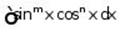 , when
  one or both are even and the other is zero, we use the formulas
  .
.
e. For integral in the form of 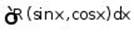 , when is a rational function, the substitution is
  .
.
In this case,  ,
,  ,
,  .
.
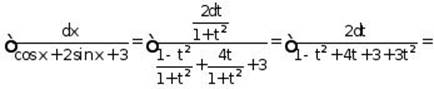
Example: To calculate 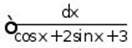 , we use the substitution
  .
.


1.7 Rational Functions Integration
a. Basic Rational Functions of Two Types
1.  ,
, 
2. 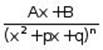 ,
, 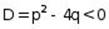 ,
,
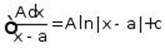
b. Integration of basic rational function of the first type:
1. 
2. 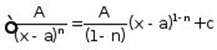 ,
, 
c. Integration of basic rational function of the second type:
If  , then, after completing the square to
 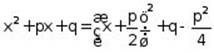 and the substitution of
  ,
,  , we get


d. For a recursive formula for finding 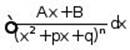 , , see integrals table in (XVI, 1.4).
e. A General Case
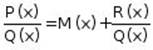
If, in rational function  , the degree of polynomial
  is higher than or equal to that of polynomial
  , that is, the function is not common, we divide
  by , and the result is the sum of polynomial
  and a common rational function (see X. 3.3)
Step 1: Break down the polynomial into factors of the form of  and
and 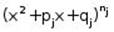 , when
  (that is, no real roots exist):

Step 2: Break down the common fraction  into a sum of unit fractions, the following way:

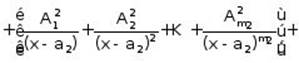



The computing of quotients  ,
,  ,
,  , is done by adding up all the fractions on the right side into one fraction, the denominator of which is . Then, by equating the denominator of this fraction to the quotients of
  , we get a system of linear equations, with the unknowns , , .
Step 3: Find the integral of the rational function this way:
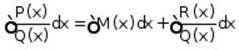
In the last integral, substitute with the right side of the equality of Step 2. This way, we get the sum of unit fractions integrals.
Example: To find the integral 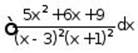 , we break down the rational function into unit fractions:

By adding the fractions of the right side, and equating numerators, we get:


After equating quotients, the result is
 ,
,  ,
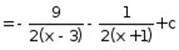
,