University Mathematics Handbook (2015)
V. Integral Calculus of Single-Variable Functions
Chapter 2. Definite Integral
2.1 Definition
Let  be a function defined on interval
  . Let's divide interval
  into subintervals by the points

We denote 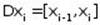 , using the same denotation for the length of all subintervals,
 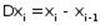 ,
,  .
.
Let us denote  . In every
  , we select an arbitrary point
  . The expression

is called Riemann sum, according to the partition to subintervals and the selected points .
Definition: function is called a Riemann integrable function, on interval , if the limit 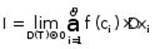 exists and is not dependent on the selection of partitions and points . We denote this limit by
  , and it is called the definite integral of function on interval , when
  and
and  in integral
  are called limits of integration.
2.2 Classes of Integrable Functions
a. If function is not bounded on interval , then it is not integrable on that interval.
b. If function is continuous in interval , then it is integrable in it.
c. A function defined and bounded in interval is called piecewise continuous function, if it has at most a finite set of discontinuities, all of which are jump discontinuities.
d. If function is piecewise continuous in interval , then it is integrable in it.
2.3 Properties of Definite Integral
a. 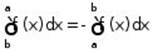
b. 
c. 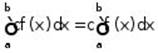 for every constant
d. 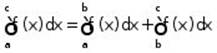
e. If  , then
 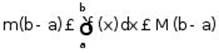 , particularly when
 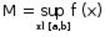 ,
, 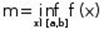 .
.
f. If and  are integrable on , then
  is integrable on interval .
g. Mean Value Theorem for Integrals
If is continuous on , then there is a point on , such that
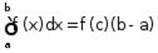
The number  is called the average value of on .
h. If  for all
  , then
 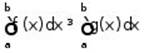 .
.
i.
1. If is integrable on , then  is also integrable in that interval and there holds
 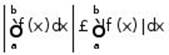 .
.
2. The inverse is incorrect. That is, if is integrable, it doesn't necessarily follow that is integrable in that interval.
j. If  and
and 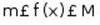 for all , then

2.4 Connection Between the Indefinite and Definite Integral
If is a continuous function and  is its antiderivative on , then:
a. 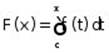 , when
b. 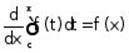
c. Newton-Leibniz Formula 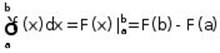
d. 
e. Cauchy-Schwartz Inequality
If and are integrable on , then:

2.5 Calculating Definite Integrals
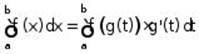
a. Change of Variables
If function is continuous on , and if function  is continuously differentiable on
  , if its image equals interval , and there holds
  and
and  , then:
b. Integration by Parts
If functions  and
and  have continuous derivatives on , then:

c. Integral of Even and Odd Functions on Interval 
If function is even and integrable on , then:
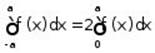
And, if function is odd and integrable on , then:

2.6 Numerical Methods of Computing Definite Integrals
We divide interval into  equal sub-intervals, by points:

when  , .
, .
a. The following formulas are rectangle approximations:



when is the midpoint of  .
.
The approximation error, in the case that is twice differentiable is 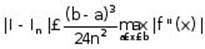 .
.
b. Trapezoid Approximation

The approximation error is 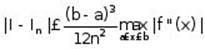
c. Simpson's Rule


when is then midpoint of  .
.
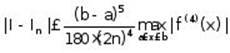
The approximation error is
2.7 Applications of Definite Integral
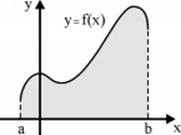
a. The area of a plane confined by the graph of non-negative function ,  -axis, and straight lines
  and
and  is
is

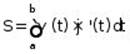
b. The Area of a plane bounded by a curve presented in the parametric form  is
is
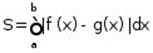
c. The area of a plane bounded by two functions ,  , above interval is
d. The area of a plane bounded by a curve presented by  ,
,  , and two rays,
  and
and  is
is
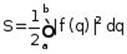
e. The length of a planar curve given by:
1)  , is
, is 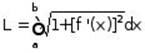
2)  ,
,  is
is 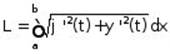
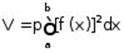
f. The volume of a solid of revolution around the  -axis of an area confined by the graph of non-negative function and the straight lines , , is
g. The volume of a solid of revolution around the -axis of an area confined by the graphs of functions and and straight lines , , is
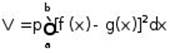
h. The volume of a solid of revolution around the  -axis of an area confined by the graph of non-negative function and the straight lines , , is
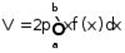
i. The volume of a solid of revolution around the -axis of an area confined by the graphs of functions and in interval is
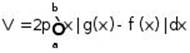
j. If a solid body is confined by planes , , and the plane  carves out of the body an area
  for every
  , then, the volume of the body is

Example: Calculate the volume of the sphere 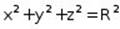 , confined between the planes
  and
and  .
.
For every situated at  , the section is circle
 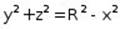 , the area of which is
 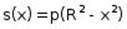 . Therefore, the volume of the sphere is
