University Mathematics Handbook (2015)
X. Algebra
Chapter 13. Inner Product Spaces
13.1 Inner Product
a.  is an inner product space over field
  if every ordered pair of vectors
  has a corresponding number of called the inner product of vectors
  and
and  and denoted
  such that:
1. 
2. 
3. 
4.  for every
  .
.
b. If is a field of complex numbers  , then is a unitary space.
c. If is a field of real numbers  , then is a Euclidean space.
d. In a Euclidean space,  .
.
e. Every finite-dimensional vector space over fiend is unitary.
f. Examples:
1. Vector space  with inner product
 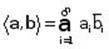 .
.
2. A space of continuous real functions on interval  with the inner product
 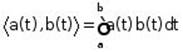 is a Euclidean space.
3. Complex matrices space  is a unitary space with the inner product

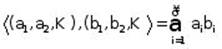
4.  is the space of all infinite sequences
  such that the series
  is convergent. The inner product of two vectors of is
13.2 Cauchy-Schwartz Inequality
a. Non-negative number  is called a length or a norm of vector .
b. For every vectors  of a unitary space, there holds:
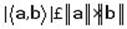
This equality holds if and only if and are linearly dependent.
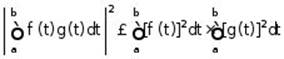
c. In a continuous functions space (see example f.2), Cauchy-Schwartz inequality is in the form of
d. Triangle inequality: The length of sum of two vectors is no greater than the sum of their lengths. That is, 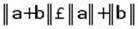 , and this equality holds if, and only if,
  (that is, and
  are parallel and in the same direction).
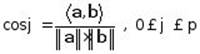
e. Angle  between non-zero vectors of vector field
  is defined by
  .
.
f. Angle exists and is unique.
13.3 Orthogonality
a. Vectors and of unitary space are orthogonal (perpendicular) if their inner product is equal to zero, that is,  .
.
b. Vector  is the only vector that is orthogonal to any other vector of .
c. Set of vectors  of unitary space is orthogonal if any two different vectors of are orthogonal.
d. An orthogonal set of non-zero vectors is linearly independent. If, in addition, it spans the space, then it is an orthogonal basis in span .
e. Gram-Schmidt theorem: every  -dimensional unitary space has an orthogonal basis. Moreover, for every linearly independent set spanning a subspace
  , there is an orthogonal set spanning .
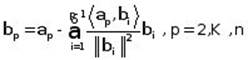
f. Gram-Schmidt orthogonalization: If 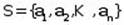 is linearly independent set, we construct a set of orthogonal non-zero vectors
  such that for every
  ,
,  the following way:
1. Define  .
.
2. Choose  such that
  is orthogonal to
  .
.
The result is 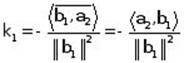 .
.
Therefore, 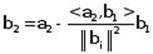 .
.
The same way we get
13.4 Orthonormal Basis
a. An orthogonal vector set is orthonormal if every vector of the set is normalized (that is, it has a unit length).
b. Every unitary space has an orthonormal basis.
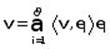
c. In unitary space , the components of a vector  in orthonormal basis
  are
are

d. If 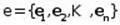 is a basis in unitary space and
  ,
,  are two vectors of , then basis
  is orthonormal if and only if the inner product of every two vectors and
  is
is  .
.
13.5 Fourier Coefficients
a. Let  orthonormal basis in unitary space and
  . Scalars
  are called Fourier coefficients of in respect to .
b. Let be an inner product space and  . The distance between
  and is non-negative number
  .
.
c. If  is an orthonormal system in vector space
  and
and  , then vector
 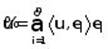 is the closest vector to
  of
of  . Moreover,
  is the unique vector of at a minimum distance from .
d. Bessel's Inequality: If is an orthonormal system on , then, for every vector  there holds:
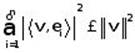
Equality holds if, and only if,  .
.
This is called Parseval's equality.
13.6 Infinite Orthonormal System
Let be an inner product space and  an infinite orthonormal system.
a. Bessel's Inequality: for every , series  converges and there holds
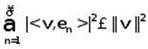
b. Let  be an infinite series of vectors in a normed space . This sequence is convergent in norm to vector
  if
if 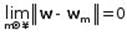 . Which means, for each
  there exists integer
  such that for each
  ,
,  holds.
c. Definition: Let  be an infinite sequence of vectors in a normed space and let
  be a scalar sequence. Series
  is said to be convergent in norm to vector , is denoted
  , if the partial sumssequence
 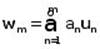 converges in norm to . In other words, series
  converges in norm to vector if
 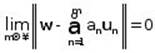 .
.
d. The proposition “vector w is spanned by infinite sequence  means there is a matching sequence of scalars such that as m increases, the combination
 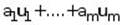 becomes an increasingly better approximation to vector w. The approximation between vectors in a normed space is measured by their distance, and consequently, the exact meaning of the last proposition is that for every
  , as small as we wish, there exists an
  such that for all
  .
.

e. Definition: Let  be an infinite orthonormal system in an inner product space . It is close in if for every
  there holds
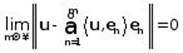
f. Orthonormal system is closed in inner product space if, and only if, for every vector there holds
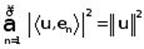
It means that the closeness is equivalent to Parseval's equality for every vector .
g. Orthonormal system  is complete in if the only unique vector holding
  is zero vector
  .
.
h. A Generalization of Parseval's Equality: If is a complete orthonormal system in inner product space , then, for every pair of vectors  there holds
 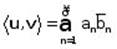 , when
  and
and 