University Mathematics Handbook (2015)
XI. Ordinary Differential Equations, or ODE
Chapter 1. Classification of First-Order Ordinary Differential Equations
1.1 Introduction
a. An ordinary differential equation, or ODE, expresses the relation between a one-variable function and its derivatives.
The general form of  -th order ODE for function
  is
is

when  is a given function of
  variables.
b. Function  is a solution of n-th-order ODE on interval
  if it is -times differentiable and satisfies the equation

c. A first-order ODE is the equation 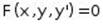 or, in its explicit form, is
  .
.
d. Example: The simplest ODE is  , and its solutions are
 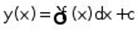 when
when  is a constant.
e. A general solution of a first-order ODE includes all solutions and is dependent on a constant . Every specific choice of , results in a particular solution.
The particular solution of that satisfies  is
is 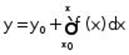 .
.
f. The problem consisting of equation and initial conditions  is called a Cauchy problem.
1.2 Separable Equations
a. Equations 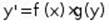 ,
,  have separate variables. Such an equation is called separable equation.
b. A general solution of 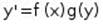 is
is
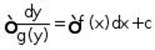
c. A general solution of the equation is
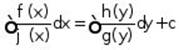
Division of both sides by  usually loses particular solutions holding
  .
.
d. The equation 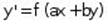 is not separable, but turns into separable equation
 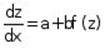 after substituting
  and its solutions are
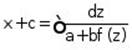 .
.
1.3 Homogeneous Equations
a.  is a
is a  -th-order homogeneous function if for every real
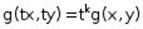 .
.
Example: Function 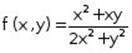 where all the powers of the numerator and of the denominator are equal is a
  -order homogeneous function.
b. ODE is homogeneous if  is -order homogeneous function.
c. Substituting  transforms the homogeneous equation into the separable equation
 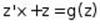 .
.
d. An equation in the form of 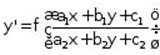 turns into homogeneous equation if the coordinates are shifted to point
  , the intersection of lines
 .
.
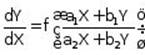
After substituting  ,
,  , we obtain homogeneous equation
1.4 Exact Equations
a. The equation  when
when  in domain
  is called exact equation. In this case there exist continuous function
  with continuous partial derivatives, such that
  and the general solution of the exact equation is
  .
.
b. If  , then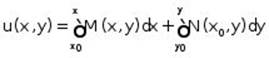
or 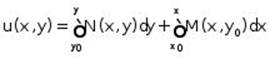
1.5 Integrating Factor
a. If the equation  is not exact, but, if multiplied it by function
  , the result is the equation

which is an exact equation, that is

Then, function is called an integrating factor.
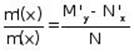
b. If the expression  is a function of
  only, then the integrating factor is a function dependent of only, and is the solution of the equation
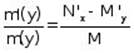
c. If the expression  is a function of
  only, then the integrating factor of the equation is dependent of only, and is the solution of the equation
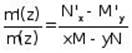
d. If the expression  is a function of
  only, then the integrating factor is a function dependent of , and is the solution of the equation
  when
when  .
.
1.6 First-Order Linear Equations
a. The ODE
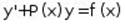 (*)
(*)
when  and
and  are continuous functions on
  is called a first-order linear equations.
b. If  , the equation is a homogeneous linear equation.
c. General solution of homogeneous linear equation 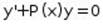 is
is 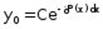 .
.
d.  is a general solution of (*).
e. Existence and Uniqueness Theorem: If functions  and are continuous in open interval
  , then there exists a unique function
  holding (*) and
  for every given
  .
.
f. Bernoulli's Equation:  . Substituting
  , we get a linear equation
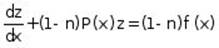
g. Riccati Equation:  .
.
If one particular solution of equation  is known, then by substituting
  we get a Bernouli equation for
  .
.
1.7 Existence and Uniqueness Theorem for First-Order ODE
Given an ODE with initial conditions (Cauchy's problem):
, (*)
a. The integral form of (*):
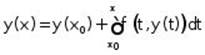
b. Existence and Uniqueness Theorem: if function is continuous on rectangle

and satisfy Lipschitz continuity criteria in 

when  is constant and
  on , then (*) has a unique solution
  on
on  when
when 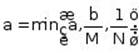 .
.
c. If and  are continuous on and
 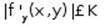 in rectangle , then Lipschitz continuity criteria holds.
d. The unique solution of a Cauchy's problem can be found using the Picard iterations, based on constructing a sequences of functions  following the formula

which converges to a solution.
e. If, under the existence and uniqueness in b, does not hold the Lipschitz continuity criteria, then (*) has a least one solution.
f. If is continuous and has continuous partial derivatives to -order, included, in the neighborhood of point , then the solution  of Cauchy's problem (*) is an
  times differentiable function.