University Mathematics Handbook (2015)
XI. Ordinary Differential Equations, or ODE
Chapter 2. Linear n-th Order Differential Equations
2.1 Definition
a. The equation
 (*)
(*)
is a  -th order linear equation.
b. If  the equation is called a homogeneous linear equation.
c. If all coefficients  are continuous functions on
  , then in the neighborhood of initial conditions
 ,
,  (**)
(**)
the Cauchy's problem (*, **) has a unique solution.
2.2 Linear Operator 
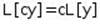
a. We denote 
b. For every fixed  :
: 
c. 
d. If  and
and  are solutions of the equation
  , then
  is also a solution of that equation.
e. If ODE with real coefficients has complex solution  , then
  and
and  are real solutions of that equation.
f. If  is a non-trivial solution of then, by substituting
  and
and  , we get an
  order ODE for
  .
.
2.3 Solutions of
a. Functions  are linearly dependent (LD) in interval
  if there exist numbers
  , not all of which are zeroes, such that
 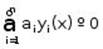 . Otherwise, functions
  are linearly independent (LI).
b. If functions  are LD on , then the determinant
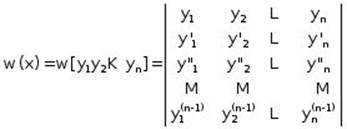
is identically equal to zero.
Determinant  is called Wronskian.
c. If LI functions  are solutions of with continuous coefficients
  on
on  , then Wronskian
  is zero nowhere on .
d. Particular solutions of , with a continuous coefficient, which are linear independent on , form a basis of the solution space.
e. Any solution  of is a linear combination of LI solutions
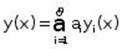
2.4 Restoring Linear ODE
a. Let be LI functions in .
We construct an  th order determinant
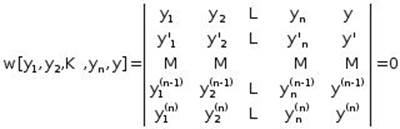
Developing it by its last column, we get a linear ODE the solutions of which are the given functions.
b. Abel's identity formula: 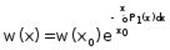
2.5 Linear Homogeneous ODE with Constant Coefficients
Let

be the n-th-order linear ODE, when  are its constant real coefficients. Then, the solutions are in the form of
  . Substituting, we get the characteristic equation

a. If the characteristic equation has different real solutions  , then
 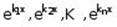 are LI solutions forming a basis of solution space. The general solution is
  when
when  are constants.
b. If the characteristic equation has complex solution  , then
  is also one of its solutions. It is written
  . Therefore, this ODE has two LI solutions,
  and
and  .
.
c. If a characteristic equation has a root  with multiplicity
  , then it fits LI solutions
  .
.
d. If a characteristic equation has complex root  with multiplicity
  , then it has
  real LI solutions:


2.6 Euler's Equation
The equation

when  are real constant coefficients, is called Euler's equation.
a. The substitution  transforms Euler's equation into a constant coefficient linear ODE.
b. We look for a solution in the form of  . The result is a characteristic equation with respect to
  :
:

c. For each real root  with multiplicity we get LI solutions

d. For each pair of complex roots  with multiplicity we get LI solutions:


2.7 Non-homogeneous Linear ODE
a. The general solution of the ODE
 (*)
(*)
is  when
when  is the general solution of the homogeneous equation and
  is a particular solution of the non-homogeneous equation, respectively.
b. The parameter variation method of finding a particular solution:
If 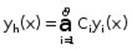 is a general solution of (*) in the homogeneous equation, we look for a solution of the following form:

Substituting it in equation (*), we construct a linear equation system with respect to  :
:
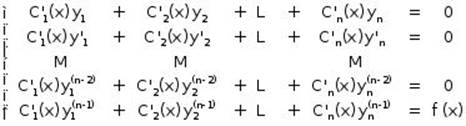
The determinant of the system is Wronskian 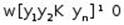 . Therefore, the system has a unique solution.
2.8 Non-homogeneous Linear ODE with Constant Coefficients
 (*)
(*)
Characteristic equation fitting (*)
 (**)
(**)
If  is one of the following functions:
1. Polynomial 
2. 
3. 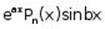 or
or 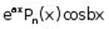
Then, we can find a particular solution of (*) on the form presented in the table, where 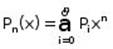 is a given polynomial,
 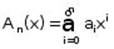 and
and 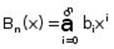 are unknown polynomials, and
  are real numbers:
|
Particular solution |
||
|
Solutions |
|
|
|
|
|
|
|
|
||


|
|
|
|
|
|
|
|
|
|
|
|
 , solution with multiplicity

 no solution
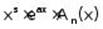
|
|
|
|
|
|
|
|
|
|
|

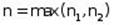
 , no solution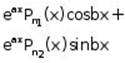

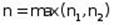
|
|