University Mathematics Handbook (2015)
XI. Ordinary Differential Equations, or ODE
Chapter 3. Series Solutions of Second-Order ODE
3.1 Solutions Near an Ordinary Point
a.  is an ordinary point of ODE
 (*)
(*)
if functions  and
and  can be developed to a power series about converging at
 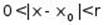 .
.
b. Theorem: If  is an ordinary point of (*) then (*) has a solution in the form of series
  with a convergence radius of at least
  .
.
c. Example: Airy equation 
 is a regular point. We look for the solution in the form
 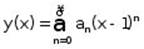 . We differentiate
  twice:

Substituting in the equation, we get:

Writing  , shifting the indexes, we get

Equating the coefficients of the same powers of  to zero, we get recursion formula
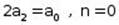

Therefore, the general solution is

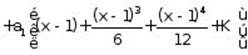
3.2 Chebyshev's Equation

a.  is an ordinary point. The general solution is


b. If  is zero or an integer, then one solution is a polynomial. Such polynomials are called Chebyshev's polynomials.
c.  ,
,  are Chebyshev's polynomials.
d. Recursion formula:

3.3 Legendre Polynomials
Legendre Equation: 
a. Its polynomial solutions  are Legendre Polynomials holding the recursion formula


b. Rodrigues formula: 
c. 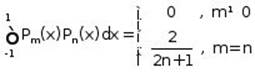
3.4 Solutions Near a Regular Singular Point
Point is a regular singular point of ODE
 (*).
(*).
If there exist finite limits
 ,
,
then the equation  (**) is called the characteristic equation of (*).
a. If the characteristic equation (**) has two different real solutions,  , the difference of which,
  , is not an integer, then (*) has two linearly independent LI solutions

b. If the characteristic equation (**) has two equal solutions  , then (*) has two LI solutions
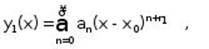

c. If  and is an integer, then (*) has two LI solutions
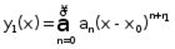 ,
, 
3.5 Bessel's Equation 
a. The General solution,  when
when

b. 
c.  are Bessel functions of the first kind
d. For  integer, the solutions of the equation are Bessel functions

e. Bessel equation 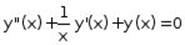 of order
  has two solutions, one unbounded in the neighborhood of
  , and another is zero-order Bessel function
 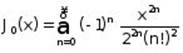 .
.