University Mathematics Handbook (2015)
XIV. Partial Differential Equations (PDE)
Chapter 3. Quasi-Linear PDE
 (*)
(*)
when  ,
,  ,
,  are of class
  (see VII.4.3).
Solution  or
or 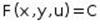 written in its implicit form is called an integral surface.
3.1 General Solution
a. Surface  is an integral surface of (*) if, and only if, in every point
  on
on  , there holds

b. An integral surface consists of characteristic curves

Therefore, vectors  and
and 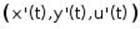 are parallel.
c. To find out all characteristic curves, we solve characteristic equation system
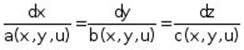 or
or 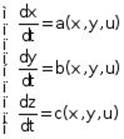 (**)
(**)
d. Theorem: If a general solution of (**) is given as the intersection of the two surfaces 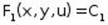 and
and 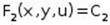 , then for every continuous function
  with partial continuous derivatives, the surface

is an integral surface of (*), for every arbitrary choice of parameters  .
.
3.2 Cauchy Problem
a. Finding integral surface  of PDE (*), passing through characteristic curve
  is a Cauchy problem.
b. Existence and Uniqueness Theorem: If, in PDE (*)
1.  in solid
  .
.
2. is a smooth, simple curve (see XII. 1.4).
3. There holds the transversality criterion

That is, if vectors 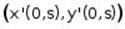 and
and  are not parallel, then there exists a unique integral surface
  containing
  .
.
c. If the transversality criterion of b. does not hold, then, when the rank of matrix

is  , the Cauchy problem has an infinite number of solutions. When
  , the Cauchy problem has no solutions.
d. Lagrange's Method of Solution:
If the general solution of characteristic equation (**) is the line of intersection between surfaces and 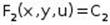 , and initial condition is also given as the intersection of surfaces
 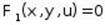 ,
, 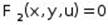 , then, out of these 4 equations, we extract
  and get a relation between
  and
and  , which is
  .
.
Substituting and ,  and
and  . We get the required solution
  (see 3.1.d).